Creative Minds 𖹭 Happy Hearts

Growing Avocados from Pits Suspended Over Water Lab Sheet
Four toothpicks and a glass of water kick off one of the most satisfying long-term experiments you can run on a windowsill. Growing avocados from pits suspended over water gives your student a front-row seat to germination, roots, and early stem growth over two to six weeks.
This lab sheet walks students through the full scientific process of growing avocados from pits suspended over water, from forming a hypothesis to recording daily observations. The observations table prompts students to note the date, describe visible changes in the pit, mark whether roots or stem and leaves have appeared, sketch the plant’s progress, and add written notes. It suits grades 3 through 6 and pairs naturally with a plant biology unit focused on germination and root development.
As a standalone long-term experiment, growing avocados from pits suspended over water builds patience and observation habits that short experiments simply cannot. Extension ideas printed on the sheet push students further by measuring weekly height, comparing two pits side by side, and researching what conditions avocado plants need to thrive. Completing the conclusion section requires students to explain what happened, offer a reason, and articulate what they learned, making this a full-cycle scientific inquiry record rather than just a progress chart.
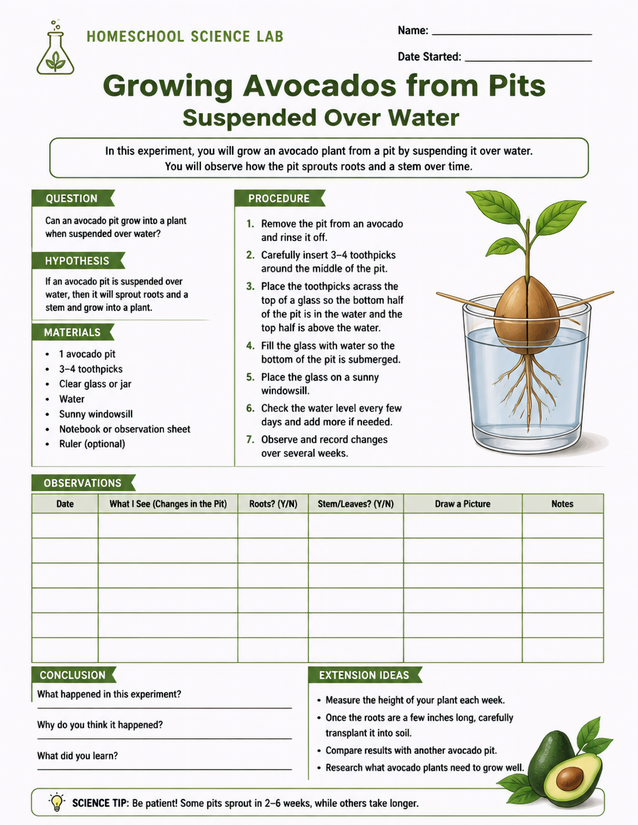
Toothpicks, a glass, and patience: this growing avocados from pits suspended over water lab sheet guides grades 3 to 6 through weeks of real plant science.
Investigating Growing Avocados from Pits Suspended Over Water

Usage Notes
Every material on this list lives in a typical kitchen or junk drawer: one avocado pit, three to four toothpicks, a clear glass or jar, water, and a sunny windowsill. A ruler is listed as optional for students who want to measure root and stem growth. No specialty supplies are needed, but supervise younger students when inserting toothpicks into the pit, since firm pressure is required and slips can happen.

Printing Tips
Twenty-pound copy paper is fine for the hypothesis and procedure sections, but the observations table will be filled in over several weeks, so 24-pound paper handles repeated handling and pencil erasures better. Hole-punch the finished sheet and add it to a science binder so your student can flip back through earlier entries as the pit develops.