Creative Minds 𖹭 Happy Hearts

Growing Bacteria Cultures on Homemade Agar Plates Lab Sheet
Doorknobs, phone screens, keyboards: growing bacteria cultures on homemade agar plates turns ordinary surfaces into five-day science you can actually see forming in real time.
Growing bacteria cultures on homemade agar plates is the kind of experiment that makes microbiology tangible for grades 5 through 8. The sheet walks your student through making agar from gelatin, sugar, and water at home, pouring it into petri dishes, collecting swab samples from surfaces like cutting boards and doorknobs, and then incubating the plates for three to five days. A structured observation table tracks colony appearance, color, shape, and size across Day 1 through Day 5, with a notes column for sketching or describing what develops.
This lab fits naturally into a unit study on microbiology, cell biology, or health science, and it works as a standalone experiment with no prior lab experience required. Five analysis questions ask your homeschooler to compare which surfaces produced the most growth, describe colony characteristics, and reflect on variables that influence bacterial growth, giving them practice with both observational recording and scientific reasoning.
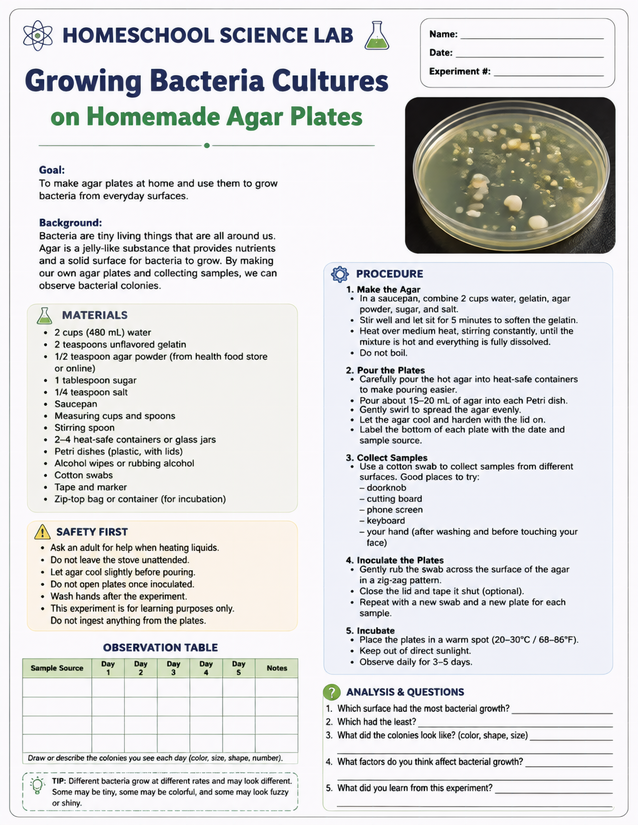
Swab everyday surfaces and track real bacterial colonies with this growing bacteria cultures on homemade agar plates lab sheet, grades 5 through 8.
Investigating Growing Bacteria Cultures on Homemade Agar Plates

Usage Notes
Most materials here are household staples: water, salt, sugar, a saucepan, measuring cups, and a stirring spoon. The one specialty item is agar powder, which the sheet notes is available at health food stores or online. Because the procedure involves heating liquids on a stovetop, the safety section explicitly calls for adult supervision during that step, and your student should handle petri dish swabs with care and wash hands after the experiment.

Printing Tips
Use 24-pound paper so the observation table holds up through repeated writing sessions over five days without buckling. A loose sheet on a clipboard works well near the incubation spot, letting your student jot daily notes without moving the plates.