Creative Minds 𖹭 Happy Hearts

Growing Different Types of Beans and Comparing Their Protein Content
Black beans, pinto beans, kidney beans: growing different types of beans side by side turns a simple planting project into a full protein comparison study your student can run start to finish.
This lab sheet walks your student through growing different types of beans under identical conditions, measuring plant height every seven days over four weeks, then harvesting, drying, and grinding the beans to test protein content using a Biuret Protein Test Kit. The data table tracks Black Beans, Pinto Beans, and Kidney Beans across Day 0 through Day 28, with columns for average height, protein test color reading, and a relative protein rank. It is designed for grades 4 through 6 and covers independent, dependent, and controlled variables explicitly so your homeschooler practices real experimental design alongside the biology.
This experiment fits naturally into a plant biology or nutrition unit study, and because the procedure runs four weeks, it works best as an ongoing strand within a longer science block rather than a single session. Completing it asks your student to form and evaluate a hypothesis, collect longitudinal growth data, operate a protein test kit, and write a conclusion that connects observations back to the original question. The safety reminders printed on the sheet flag blender use, chemical handling, and the instruction not to eat beans after testing, which gives you a built-in moment to discuss lab safety before your student touches a single pot.
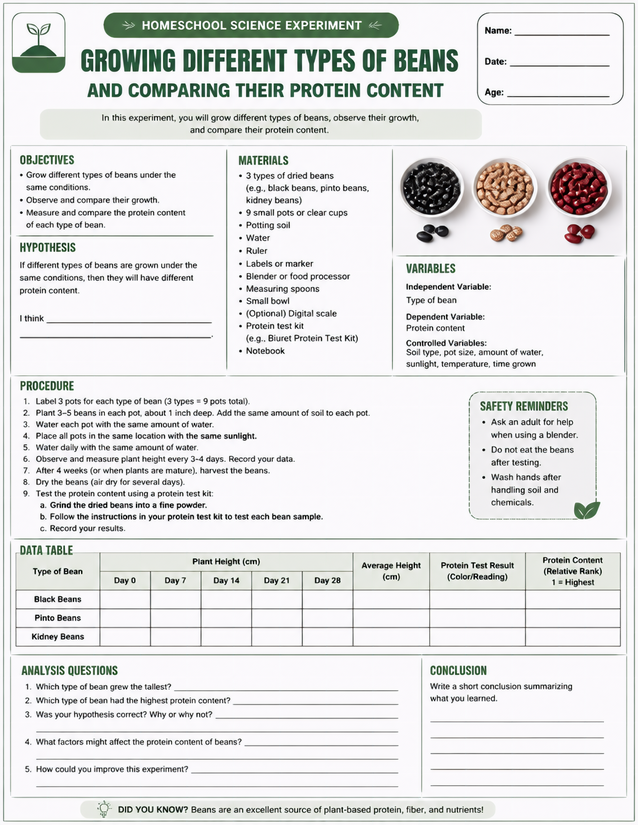
Grades 4 through 6 will love this growing different types of beans experiment, tracking plant height and protein content across three bean varieties.
Setting Up Growing Different Types of Beans at Home

Usage Notes
Nine small pots or clear cups, potting soil, water, a ruler, labels, and measuring spoons are all standard household supplies. The protein testing step requires a Biuret Protein Test Kit, which is a specialty item you will need to order in advance. A blender or food processor is needed to grind the dried beans into powder before testing, so review the safety reminder on the sheet with your student before that step.

Printing Tips
Print on 24-pound paper so the data table holds up through repeated writing sessions over four weeks of measurements. Keep it as a loose sheet clipped to a clipboard near the growing area so your student can record plant heights without carrying a whole notebook, then file it into a lab binder once the experiment wraps.