Creative Minds 𖹭 Happy Hearts

Growing Morning Glories and Studying Their Circadian Rhythms
Open or closed at midnight? Growing morning glories circadian rhythms lab puts that question to the test across three controlled light conditions over multiple days.
Your student plants morning glory seeds, grows them to flower, then divides them into three groups: a normal day and night cycle, constant light under a grow lamp, and constant dark inside a light-proof box. Every two to three hours for at least three days, they record whether each flower is open or closed, note the time and light condition, and add any other observations. The data table on this growing morning glories circadian rhythms lab sheet tracks six observation windows per day across all three groups, giving grades 5 through 8 a structured way to explore whether the plant’s rhythm is truly internal or just a response to light cues.
This experiment fits naturally into a botany or biology unit study, especially one covering plant behavior, internal clocks, or the science of living systems. It works as a standalone multi-day investigation or as a capstone to a broader unit on circadian biology. By the time your homeschooler reaches the analysis and conclusion section, they are drawing on several days of real data to answer whether morning glories continue their rhythm even when light conditions are manipulated, a genuine scientific inference rather than a fill-in-the-blank exercise.
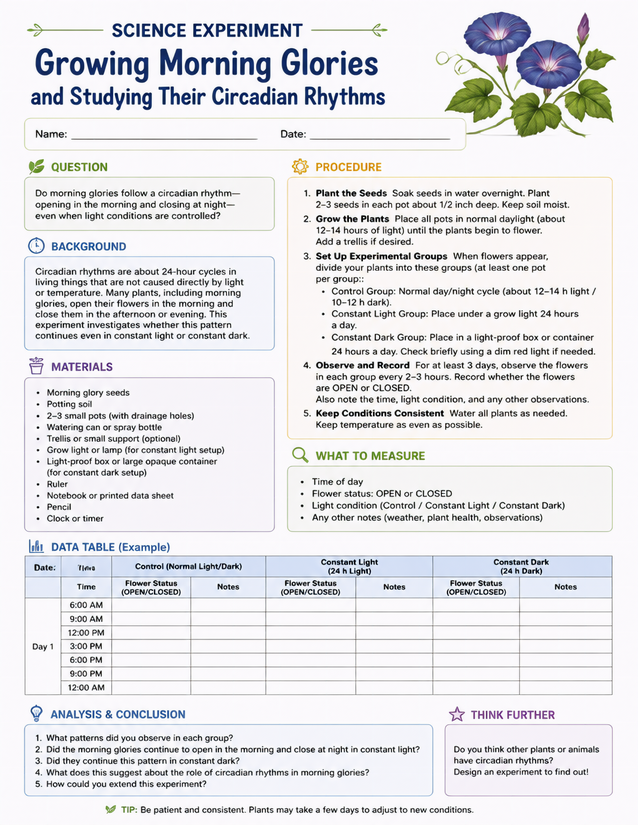
Observe growing morning glories circadian rhythms across three light conditions with this detailed homeschool lab sheet for grades 5 through 8.
Investigating Growing Morning Glories Circadian Rhythms at Home

Usage Notes
Morning glory seeds, potting soil, and two to three small pots with drainage holes are the core supplies, and most are available at a garden center for a few dollars. The constant light group requires a grow light or lamp running continuously, and the constant dark group needs a light-proof box or large opaque container. One safety note implied by the sheet: the dim red light used to check the dark group should be kept brief so it does not disrupt the experimental condition.

Printing Tips
Standard 20-pound copy paper is fine for the data table if your student fills it in at a desk, but 24-pound paper holds up better if the sheet sits near a plant shelf where it may catch moisture. Slip it into a plastic page protector inside a lab notebook to keep it flat across the multi-day observation period.