Creative Minds 𖹭 Happy Hearts

Growing Mushrooms from a Kit, Observing Their Growth
Fungi don’t need sunlight, and that makes growing mushrooms from a kit one of the most surprising first experiments a young scientist can run from the kitchen counter.
Your student tracks real fungal growth over ten days plus a final harvest entry using this structured lab sheet. The observation table captures daily written notes, the height of the tallest mushroom in centimeters, and a checkbox for photos or drawings, giving grades 3 through 7 a concrete, measurable record of biological change. Four reflection questions push beyond the data table, asking your homeschooler to identify peak growth days, theorize about what conditions fungi need, and name their most surprising observation.
Growing mushrooms from a kit fits naturally into a life science or botany unit study, and it runs alongside lessons on fungi, decomposers, or the differences between plants and fungi. The included Did You Know box, which notes that mushrooms draw nutrients from the growing medium rather than sunlight, gives you a ready discussion prompt. A student who completes this sheet demonstrates observation skills, basic measurement, and the ability to connect raw data to a testable conclusion.
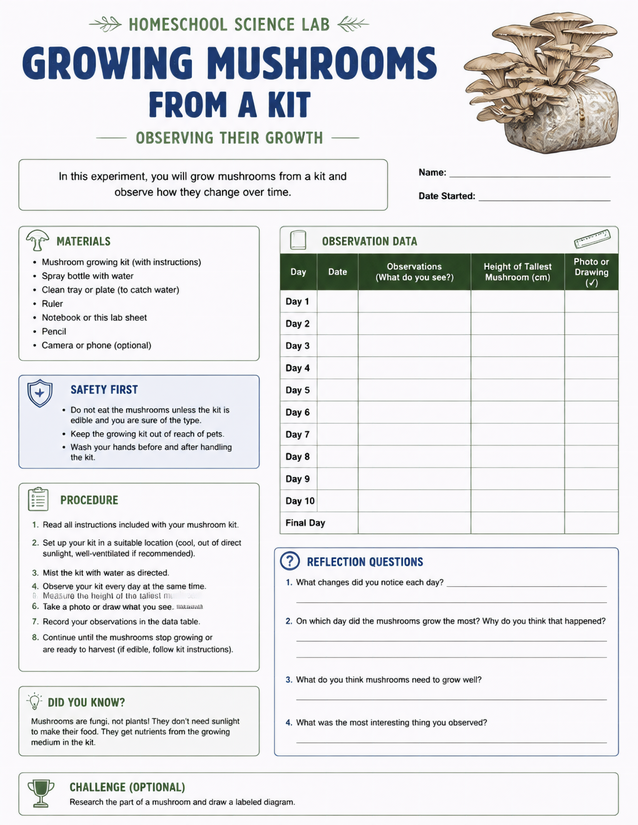
Record daily height measurements and observations with this growing mushrooms from a kit homeschool lab sheet, suited for grades 3 through 7.
Getting Started with Growing Mushrooms from a Kit

Usage Notes
All materials listed are household items or easy to source: a mushroom growing kit, spray bottle, clean tray, ruler, pencil, and an optional camera or phone. No specialty lab supplies are needed, which makes setup straightforward for most homeschool families. The safety section flags one important note, that students should not eat the mushrooms unless the kit is confirmed edible, so confirm kit type before harvesting.

Printing Tips
Standard 20-pound copy paper works fine for daily recording since students write lightly in the table cells, but 24-pound paper holds up better if the sheet gets misted accidentally during kit care. Slip it into a clipboard near the growing kit so your student can record observations at the same time each day without hunting for the sheet.