Creative Minds 𖹭 Happy Hearts

Growing Plants in Clay Soil Versus Sandy Soil Science Experiment
Side by side in the same sunlight, same water, same seed, the clay soil versus sandy soil experiment lets the soil do the talking over seven days of daily measurement.
Your student records plant height, leaf count, and overall appearance every day for a week, comparing one bean seed grown in clay soil against another in sandy soil. The sheet walks through the scientific method from hypothesis to conclusion, making it a solid standalone experiment for grades 3 through 6 working on plant biology or earth science.
The clay soil versus sandy soil experiment fits naturally into a soil science unit study or as a hands-on complement to lessons on plant needs and water retention. By the time your homeschooler writes the conclusion, they have real data to explain why soil type affects drainage, root health, and growth rate, not just a definition to memorize.
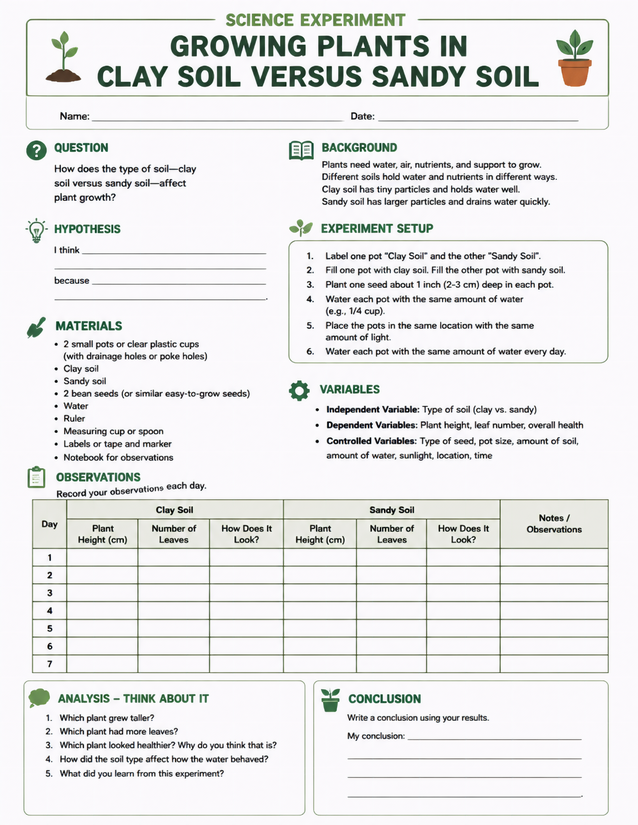
Grades 3 through 6 will love this clay soil versus sandy soil experiment, tracking plant height, leaf count, and overall health across seven days.
Investigating the Clay Soil Versus Sandy Soil Experiment Step by Step

Usage Notes
Bean seeds, two small pots or clear plastic cups with drainage holes, clay soil, sandy soil, a measuring cup, ruler, and labels are all you need. Clay and sandy soil are the only items that may require a quick hardware or garden store run if you do not have both types on hand. No heat sources or chemicals are involved, so this is a low-supervision setup once the pots are prepared.

Printing Tips
Standard 20-pound copy paper works fine for daily entries, but 24-pound paper holds up better if the sheet will sit near a watering area where moisture is likely. Loose sheets on a clipboard make it easy to carry to wherever the pots are placed, and the seven-day table is compact enough to slip into a science notebook after the experiment wraps.