Creative Minds 𖹭 Happy Hearts

Growing Plants in Complete Darkness Lab Sheet, Etiolation Study
Pale stems, no true leaves, floppy and reaching for nothing: growing plants in complete darkness turns a normal seedling into a textbook example of etiolation your student built themselves.
This lab sheet walks your student through a 7 to 14 day experiment comparing two identical pots of fast-growing seeds, one kept in natural light and one sealed inside a lightproof cardboard box wrapped in aluminum foil or black paper. Your homeschooler records height measurements on days 1, 3, 5, 7, 10, and 14 in a structured data table, then notes color, leaf development, and stem strength for each pot. The sheet is well suited for grades 4 through 7 and includes a hypothesis prompt, a background explanation of etiolation, and a challenge extension asking what happens when the dark-grown plant is returned to light.
Growing plants in complete darkness is a strong standalone unit study topic and fits naturally into a botany or plant biology sequence. By completing the observation, data table, and conclusion sections, your student demonstrates understanding of photosynthesis, phototropism, and why light is a non-negotiable variable for healthy plant growth. The safety reminders printed on the sheet, covering mold prevention, not eating plant material, and hand-washing after handling soil, mean you can hand this directly to your homeschooler and step back.
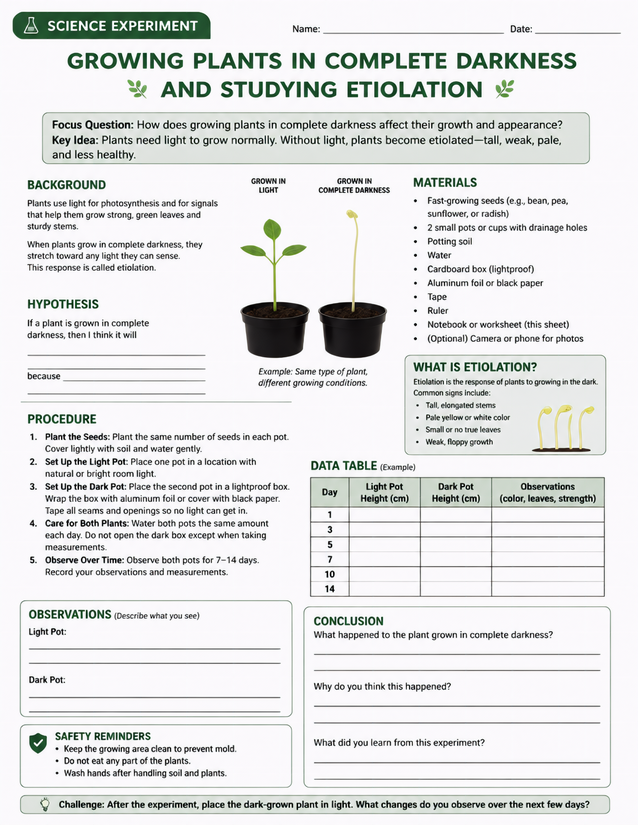
Grades 4 to 7 homeschoolers can use this growing plants in complete darkness lab sheet to study etiolation over 14 days.
Investigating Growing Plants in Complete Darkness Over 14 Days

Usage Notes
Nearly every material on the list is already in most homes: fast-growing seeds such as bean, pea, or radish, two small pots with drainage holes, potting soil, water, tape, and a ruler. The one specialty item is a lightproof enclosure, but the sheet specifies a cardboard box sealed with aluminum foil or black paper, which costs almost nothing. No open flames or chemicals are involved, though the sheet does flag mold prevention and hand-washing after soil handling as safety steps worth reviewing before your student starts.

Printing Tips
Standard 20-pound copy paper works for a single-use sheet clipped to a clipboard beside the growing pots, but 24-pound paper holds up better if the sheet will be handled daily for two weeks. Slide it into a lab notebook after the experiment is complete so height data and observations stay with the conclusion.