Creative Minds 𖹭 Happy Hearts

Radishes Fertilizer Concentration Experiment, Plant Height and Root Data
Five pots, five fertilizer concentrations, and one question worth investigating: the radishes fertilizer concentration experiment turns a bag of seeds into a controlled variable study your student can run on a windowsill.
Your student will test how increasing fertilizer concentration affects both plant height and root length in radishes, using five labeled pots ranging from a 0% control to a 200% solution of balanced liquid fertilizer. The sheet walks through experiment setup, a fertilizer concentration table with exact milliliter measurements for each solution, a data table for recording plant height every two to three days from Day 0 through Day 15, and a final root length row measured at harvest. Designed for grades 5 to 7, this radishes fertilizer concentration experiment introduces controlled variable design at a scale a homeschool student can manage independently over two weeks.
This lab fits naturally into a plant biology unit study covering nutrients, growth factors, or experimental design. It works as a standalone investigation or as a paired comparison alongside a soil amendment or hydroponics experiment you may already have in your curriculum. By completing the analysis section, your student demonstrates the ability to interpret multi-variable data, propose a follow-up hypothesis, and draw a conclusion from real-world observations rather than a textbook diagram.
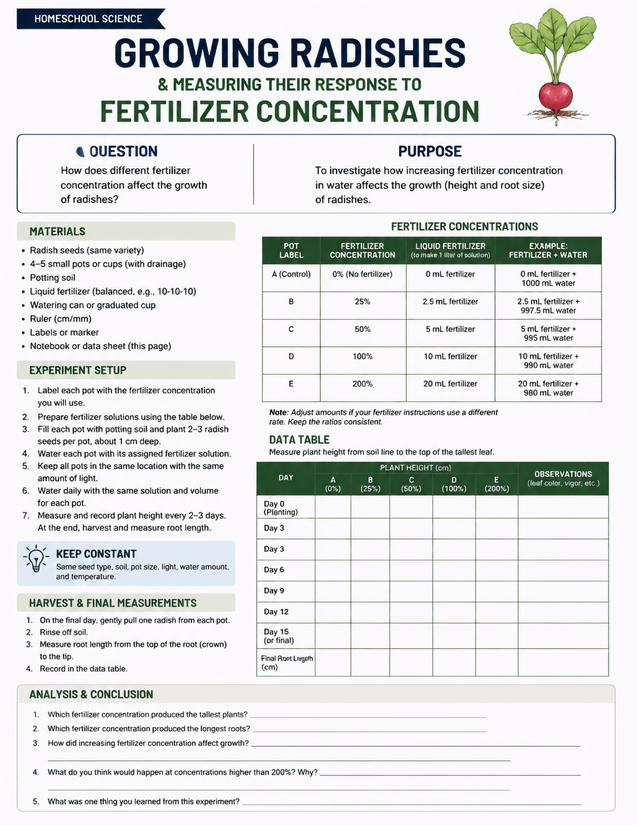
Five fertilizer concentrations, one growing season: the radishes fertilizer concentration experiment gives grades 5-7 homeschoolers measurable plant science results.
Investigating the Radishes Fertilizer Concentration Experiment Week by Week

Usage Notes
Balanced liquid fertilizer (a 10-10-10 formula is specified) is the one specialty supply here; everything else, including radish seeds, small pots, potting soil, a ruler, and a watering can, is easy to source at a garden center or hardware store. Five pots with drainage holes are required, so verify you have those before planting day. No heat or chemicals beyond standard liquid fertilizer are involved, but remind your student to wash hands after handling soil and fertilizer solution.

Printing Tips
Heavyweight 28-pound paper holds up better than standard copy paper when students are writing in data over two weeks of daily handling. Punch holes along the left edge and slip it into a dedicated lab notebook so the data table stays flat and legible through the full 15-day observation period.