Creative Minds 𖹭 Happy Hearts

Growing Sunflowers and Measuring Their Growth Rate
Fourteen days, one seed, and a ruler: the growing sunflowers and measuring growth rate experiment gives your student a front-row seat to plant biology in real time.
Structured around a 14-day observation window, this lab sheet walks your student through planting one or two sunflower seeds in a pot, watering consistently, and measuring height from the soil line to the tallest point of the plant each day. The data table records the date, height in centimeters, and growth since the previous day, so your student builds number sense alongside science skills. It suits grades 3-6 well, with the hypothesis and variables sections offering enough rigor for older students while remaining accessible to younger ones.
The growing sunflowers and measuring growth rate sheet works naturally inside a botany or life science unit study, sitting after a lesson on seed anatomy and before a broader conversation about plant needs and photosynthesis. Your student identifies independent and dependent variables, calculates average daily growth, and writes a short conclusion, demonstrating both scientific method and basic data analysis. It functions as a standalone two-week experiment or as the hands-on anchor for a longer plants unit.
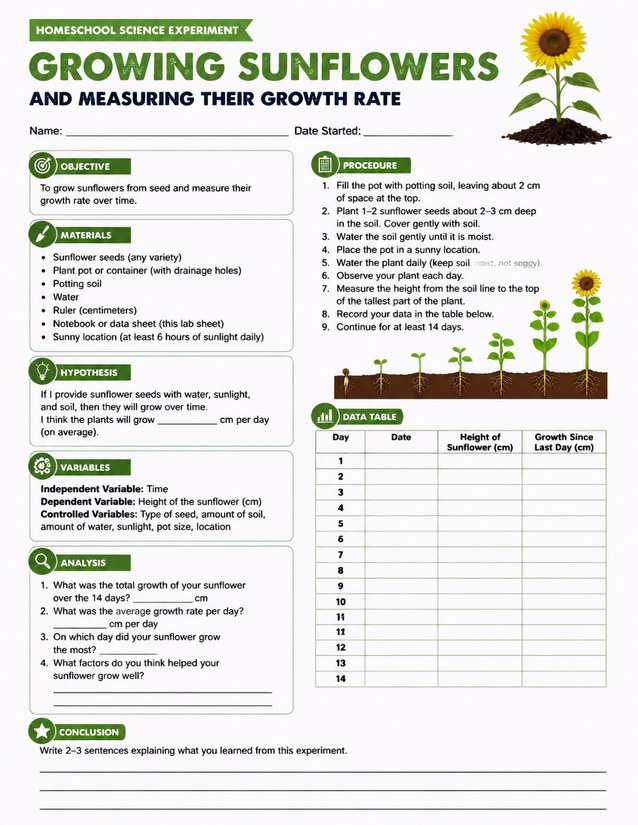
Track your sunflower’s daily height with this growing sunflowers and measuring growth rate lab sheet, suited for grades 3-6.
Getting Started with Growing Sunflowers and Measuring Growth Rate

Usage Notes
Sunflower seeds, potting soil, a plant pot with drainage holes, water, and a centimeter ruler cover everything the materials list requires, all household or garden-center basics. No specialty supplies are needed, which keeps setup simple for any homeschool day. The sheet reminds students to keep soil moist but not soggy, so a brief conversation about overwatering is worth having before your student fills the pot.

Printing Tips
Twenty-four-pound paper gives the data table enough weight to hold up to two weeks of daily pencil entries without ghosting through. Slip the sheet into a plastic page protector inside a science lab notebook, or keep it loose on a clipboard near the growing pot so measuring and recording happen in one step.