Creative Minds 𖹭 Happy Hearts

Growing Tomatoes From Seed Science Experiment Lab Sheet
Seed to fruit, every centimeter measured. This growing tomatoes from seed experiment gives your student a structured way to watch germination happen in real time and put numbers to what they see.
Structured around the guiding question ‘How do tomato seeds grow and change over time?’, this lab sheet walks students through a full scientific investigation, from forming a hypothesis to recording daily data across six columns: date, days since planting, observations, plant height in centimeters, number of leaves, and a drawing of what the plant looks like that day. A tomato variety field at the top lets your homeschooler compare results across different cultivars if you choose to run the experiment in parallel. This growing tomatoes from seed experiment is well suited for grades 2-5 and works as a standalone life science unit or as part of a broader botany or plant biology study. Four written analysis questions at the bottom ask students to describe what happened first, how the plant changed over time, what surprised them, and what they learned, moving beyond data collection into genuine scientific reflection. A final sketch box prompts a careful drawing of the finished plant, rounding out the observation cycle.
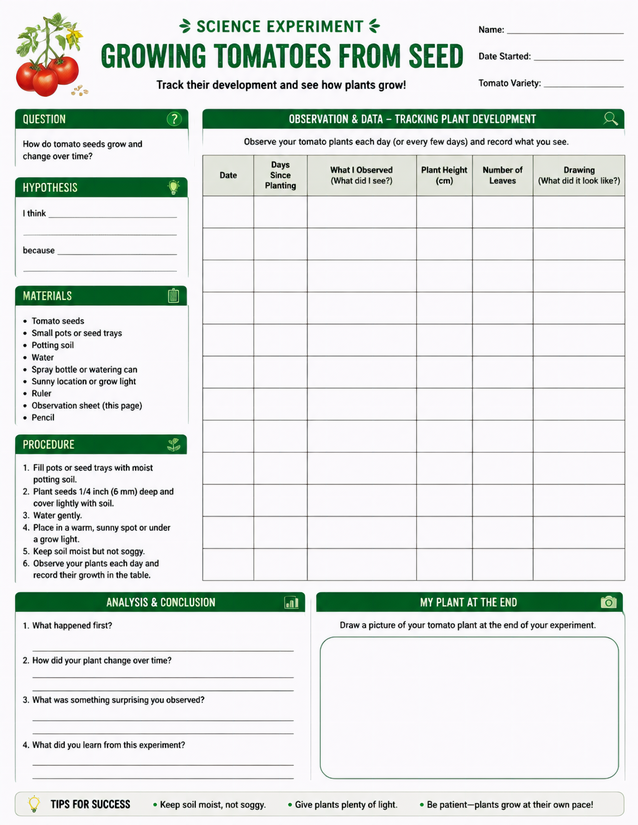
Record daily plant height, leaf count, and drawings with this growing tomatoes from seed experiment worksheet, suited for grades 2-5.
Recording Results for the Growing Tomatoes From Seed Experiment

Usage Notes
Tomato seeds, small pots or seed trays, potting soil, water, a spray bottle or watering can, and a ruler are the only materials listed, all household or easily sourced at a garden center. A grow light is listed as an alternative to a sunny windowsill, which is worth noting if your homeschool space has limited natural light. No safety hazards are implied, though keeping soil moist but not soggy is called out explicitly as a success tip on the sheet itself.

Printing Tips
Cardstock or 24-pound paper holds up better than standard copy paper when resting on a clipboard next to a grow tray. Because the data table spans multiple weeks, print one sheet per student rather than laminating, so the handwritten measurements become a permanent record worth keeping in a science portfolio.