Creative Minds 𖹭 Happy Hearts

Growing Watercress in Different Types of Water Lab Sheet
Four shallow dishes, four water types, and one question worth two weeks of careful watching: growing watercress in different types of water turns a kitchen counter into a controlled science experiment.
Your student begins by writing a hypothesis, then sets up four identical containers, each receiving a different water type: filtered, tap, distilled, or spring. The data table on the sheet tracks average plant height in centimeters at days 1, 3, 5, 7, 10, and 14, alongside an observations column for leaf color, leaf size, and number of leaves. This growing watercress in different types of water lab is well matched to grades 4-7 homeschool science and builds direct experience with controlled variables and fair-test design.
The sheet works as a standalone two-week unit or inside a broader plant biology or water quality unit study. By the time your homeschooler circles either ‘Supported’ or ‘Not Supported’ in the conclusion section, they have practiced forming a hypothesis, holding variables constant, collecting daily quantitative data, and drawing an evidence-based conclusion. The included science tip, which reminds students to change only one variable, reinforces the logic of experimental design without needing a separate lesson.
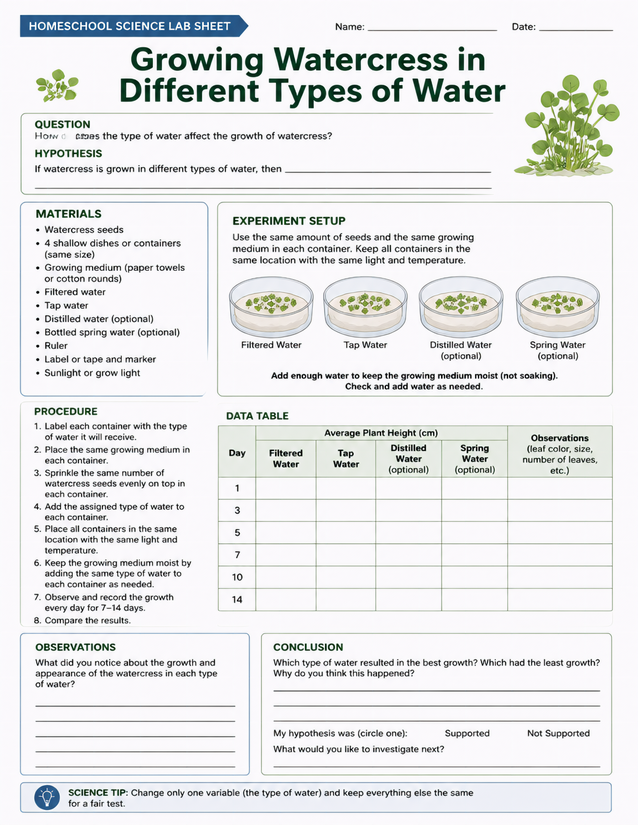
Grades 4-7 homeschool science: growing watercress in different types of water over 14 days. Filtered, tap, distilled, and spring water compared.
Investigating Growing Watercress in Different Types of Water

Usage Notes
Watercress seeds and shallow dishes or petri-style containers are the specialty items here; everything else, including paper towels or cotton rounds as growing medium, tap water, a ruler, and labels, is already in most households. Distilled and bottled spring water are listed as optional, but including them makes the comparison more meaningful. No open flames or chemicals are involved, so safety setup is minimal.

Printing Tips
Twenty-four-pound paper gives the data table columns enough body to hold repeated pencil entries without ghosting through. Keep it as a loose sheet on a clipboard stationed near the experiment so your student can record observations at a glance each day rather than carrying a notebook back and forth.