Creative Minds 𖹭 Happy Hearts

Making a Barometer with a Jar and Balloon
Seven steps and a glass jar are all it takes: making a barometer with a jar and balloon turns daily weather into a hands-on data collection project your student can actually see move.
Making a barometer with a jar and balloon is the central task on this lab sheet, which walks your student through stretching a balloon over a jar opening, threading a straw through the balloon, and marking a centimeter scale to track straw movement over several days. The observation table records date, time, straw level in centimeters, weather conditions, and open notes, giving grades 4-7 homeschoolers a genuine multi-day data set to analyze. A “How It Works” section explains the relationship between high pressure pushing the balloon down and low pressure allowing it to rise, connecting the physical instrument to the weather patterns your student is already watching.
This sheet fits naturally into a weather or earth science unit study, and it works as a standalone project without any prior lab sequence. Completing it asks your student to form a question, gather materials, follow a seven-step procedure, and write a conclusion, covering the full scientific method in one approachable build. The built-in science tip about keeping the barometer away from direct sunlight and drafts gives your homeschooler a real variable to think critically about before results come in.
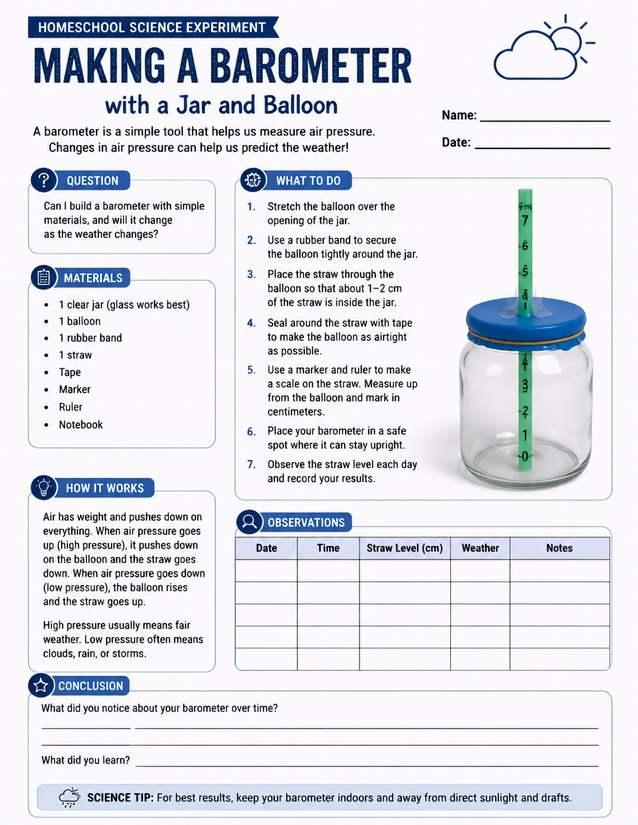
Making a barometer with a jar and balloon teaches air pressure concepts for grades 4-7 using five common household items.
Investigating Making a Barometer with a Jar Over Multiple Days

Usage Notes
Every supply on the materials list is a household item: a clear glass jar, one balloon, a rubber band, a straw, tape, a marker, a ruler, and a notebook. No specialty purchases are needed, which makes this experiment easy to run on short notice. The only safety consideration is ensuring the balloon is stretched tightly and taped securely so the seal stays airtight throughout the observation period.
Printing Tips
Standard 20-pound printer paper is fine here since students write in the observation table over multiple sittings rather than during active construction. Keep the sheet loose on a clipboard near wherever your student places the barometer, so daily readings can be recorded without moving the instrument.