Creative Minds 𖹭 Happy Hearts

Making a Homemade Spectrophotometer, Smartphone and Diffraction Grating
Making a homemade spectrophotometer with a cardboard box and a smartphone sounds ambitious until your student photographs a spectrum and calculates absorbance with actual math.
Built around a shoebox, a diffraction grating, and a white LED, this lab sheet walks your student through constructing a working spectrophotometer from scratch and then using it to measure how much light a colored solution absorbs at different wavelengths. The sheet covers the full build in five labeled steps, a seven-step procedure, and a data analysis section that includes transmittance and absorbance formulas. It suits grades 7-10 in a homeschool science curriculum, particularly within a chemistry, optics, or physics unit study.
Making a homemade spectrophotometer at this level asks your student to do more than follow directions. They calculate transmittance by comparing sample and blank photographs, apply the logarithmic absorbance formula, plot absorbance versus wavelength, and identify the wavelength of maximum absorbance. The experiment ideas section extends the lab further, prompting comparisons between food coloring spectra, concentration effects, and unknown solution identification, giving you a sequence that can anchor multiple sessions rather than a single afternoon.
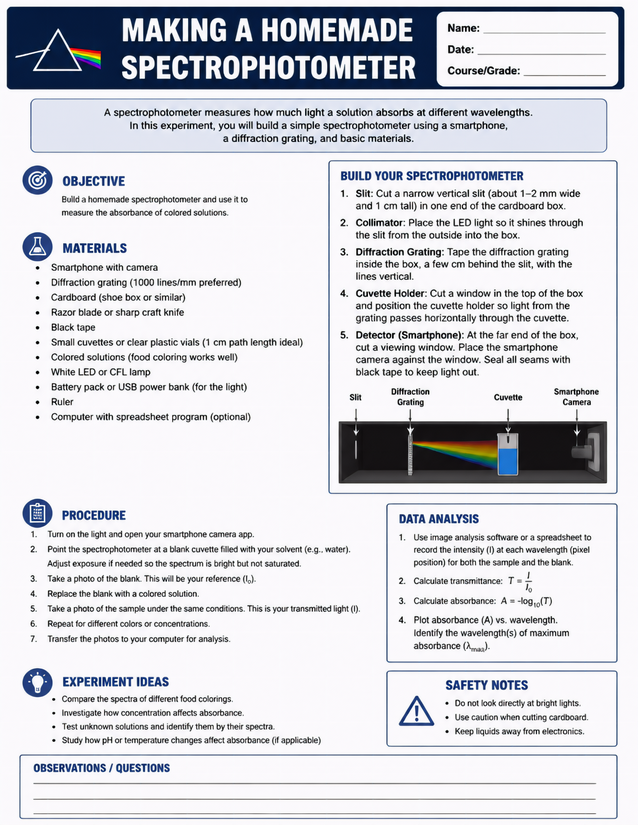
Grades 7-10 homeschoolers build a real spectrophotometer using a smartphone and diffraction grating. Making a homemade spectrophotometer has never been this accessible.
Setting Up Making a Homemade Spectrophotometer in Your Lab

Usage Notes
Razor blades and sharp craft knives are on the materials list for cutting the cardboard slit and cuvette window, so supervise that step closely with younger students. Most supplies are household items or easy finds: a shoebox, black tape, a USB power bank, and small plastic vials. The one specialty item is a diffraction grating rated at 1000 lines per millimeter, which is inexpensive but requires ordering ahead.

Printing Tips
Print on 24-pound paper so the sheet holds up on a clipboard next to the build without going limp. Keep it as a loose sheet rather than inserting into a notebook during construction, then transfer it to your science binder once the data analysis section is complete.