Creative Minds 𖹭 Happy Hearts

Making a Model Heart Pump with Plastic Bottles and Tubing
Four plastic bottles, some tubing, and food coloring are all it takes for making a model heart pump that actually moves liquid through two circuits just like the real thing.
Your student builds a four-chamber heart model using plastic bottles as atria and ventricles, plastic tubing as blood vessels, and drinking straws trimmed into one-way valves. Blue water represents deoxygenated blood in the right side, red water represents oxygenated blood in the left side, and squeezing each ventricle shows exactly how pumping pressure moves fluid through the pulmonary and systemic circuits. This lab sheet is well suited for grades 5 through 8 and works as a hands-on centerpiece for a human body or circulatory system unit.
Making a model heart pump this way gives your homeschooler a concrete look at a process that textbook diagrams alone rarely make click. The sheet walks through assembly in ten numbered steps, then asks five observation questions comparing the model to the real heart, including why the straw valves matter and what limits the model. A conclusion prompt asks students to propose improvements, which pushes the thinking past construction into genuine scientific evaluation.
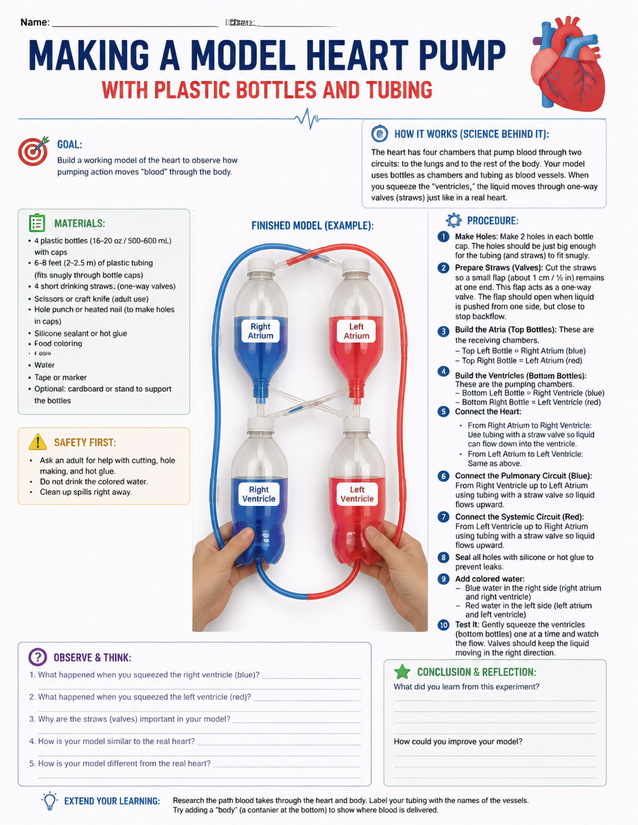
Grades 5-8 homeschoolers explore circulation by making a model heart pump using plastic bottles, tubing, and colored water.
Getting Started with Making a Model Heart Pump

Usage Notes
Four 16-20 oz plastic bottles with caps are the structural core, and 6-8 feet of plastic tubing plus four short drinking straws are the only non-household items you may need to source. Scissors, food coloring, silicone sealant or hot glue, and a hole punch or heated nail round out the list, all things most homeschool families keep on hand. The sheet flags adult supervision for cutting and hot glue use, so plan to work alongside your student for those assembly steps.

Printing Tips
Card stock at 65 lb holds up better than copy paper when the sheet is sitting on a wet or cluttered work surface during assembly. A loose sheet on a clipboard works well here since students reference the procedure column while their hands are busy with the bottles. Laminating is not ideal for this sheet because students write in the observe-and-think section mid-experiment.