Creative Minds 𖹭 Happy Hearts

Enzyme and Substrate Interaction Model Lab Sheet
Modeling lock-and-key chemistry with clay makes the enzyme and substrate interaction model click in a way that textbook diagrams rarely do.
Your student builds a physical model of enzyme action using two colors of modeling clay or Play-Doh. The sheet walks through six numbered steps: shaping an enzyme with an active site pocket, forming a substrate that fits precisely into that site, demonstrating binding, replacing the substrate with smaller product pieces, and finally showing the enzyme released unchanged and ready to act again. Five labeled observation boxes prompt your student to draw each stage, and two analysis questions ask why shape specificity matters and what would happen if the shapes did not match. This enzyme and substrate interaction model is well suited for grades 6 through 9 studying cell biology or biochemistry.
The lab fits naturally into a life science unit study on how cells carry out chemical reactions, and it pairs cleanly with lessons on digestion, metabolism, or protein function. Completed independently in one sitting, it demonstrates whether your homeschooler understands active sites, specificity, and enzyme reuse well enough to explain the sequence in their own drawings and written conclusions. The conclusion prompt, asking what your student learned about enzymes and substrates, doubles as a low-stakes formative assessment you can file alongside the model itself.
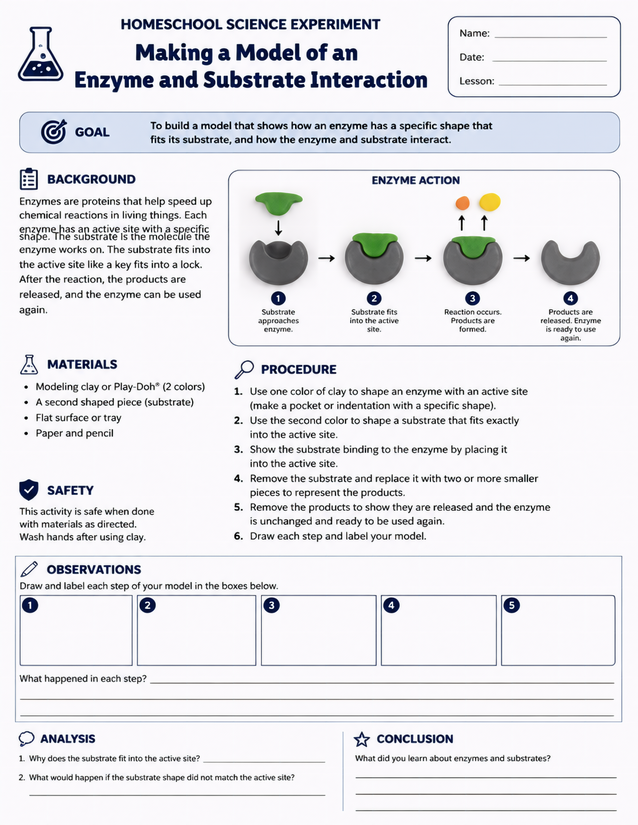
Grades 6-9 homeschoolers explore the enzyme and substrate interaction model using clay in this hands-on lab sheet.
Investigating the Enzyme and Substrate Interaction Model with Clay

Usage Notes
Modeling clay or Play-Doh in two distinct colors is all the sheet requires, alongside a flat surface or tray and paper and pencil for labeling. Both supplies are standard household items for most homeschool families, so no specialty sourcing is needed. The safety note on the sheet is minimal: wash hands after handling clay, which is worth a quick reminder before your student starts.

Printing Tips
A single sheet on 24 lb paper holds up better than copy-weight stock when a student is pressing and shaping clay nearby and needs to reference the procedure repeatedly. Slip it into a clear page protector inside a science lab notebook so the observation boxes stay clean while clay work is underway.