Creative Minds 𖹭 Happy Hearts

Making a Model of Chromosomes, Pipe Cleaner Lab Sheet
Pipe cleaners twisted into an X shape suddenly make sister chromatids and centromeres click into place. Making a model of chromosomes gives your student a physical reference point that diagrams alone rarely deliver.
Making a model of chromosomes is the hands-on core of this lab sheet, which walks students through a nine-step procedure: aligning two pipe cleaners of the same color, crossing them at the midpoint, securing a bead or pom-pom as the centromere, and bending the arms into the p-arm and q-arm configuration. An example photo on the sheet shows a purple X-shaped model with a yellow bead, giving students a visual target as they build. The Observe and Think section closes the activity with four written reflection questions about shape, biological purpose, and how the model compares to a real chromosome. This lab fits naturally into a grades 5-8 cell biology or genetics unit study, whether your homeschooler is working through a full genetics sequence or needs a standalone lesson on chromosome structure. The optional extension asks students to build a pair of homologous chromosomes in two different colors, one from mom and one from dad, deepening their understanding of inherited traits. A challenge prompt at the bottom invites further research into the total chromosome count in a human cell, adding a self-directed inquiry layer to an already complete activity.
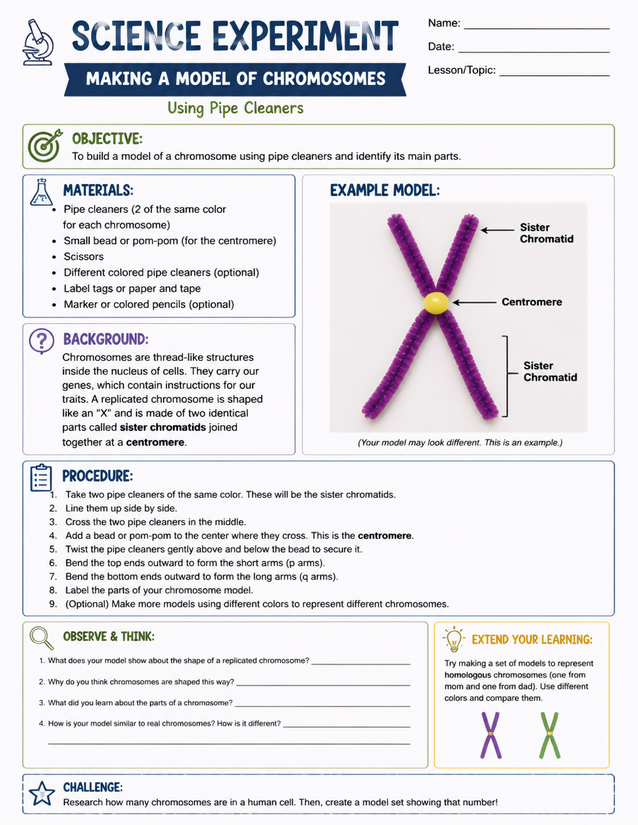
Grades 5-8 homeschoolers explore making a model of chromosomes using pipe cleaners and beads to label sister chromatids and the centromere.
Getting Started with Making a Model of Chromosomes

Usage Notes
Pipe cleaners are the primary material, with two of the same color needed per chromosome. The centromere calls for a small bead or pom-pom, and the sheet also lists scissors, label tags or paper and tape, and a marker as supplies. All materials are standard household or craft-bin items, and scissors are the only tool requiring supervision for younger students.

Printing Tips
A single loose sheet on a clipboard works well here since students build the model at a table alongside the printed instructions. Standard copy paper is fine, but 24 lb paper holds up better if the sheet gets handled repeatedly during the building steps. Laminating is not ideal because students need to write in the Observe and Think responses.