Creative Minds 𖹭 Happy Hearts

ATP Energy Cycle Model Lab Sheet, Grades 6-8
Foam balls snap apart, paper clips pop free, and suddenly ATP is not a textbook abstraction. This ATP energy cycle model lab sheet turns phosphate bond chemistry into something your student can hold in their hands.
The ATP energy cycle model lab sheet walks grades 6-8 homeschoolers through building a physical model of adenosine triphosphate using foam balls or beads for phosphates, pipe cleaners or string for bonds, and paper clips to represent high-energy bonds that break and reform. Students follow five numbered steps: assembling ATP, labeling each part, removing a phosphate to simulate energy release, reattaching it to show recharge via ATP synthase, and repeating the cycle. Observation questions ask what happened when a phosphate was removed, what the released energy does in a cell, and where cells get energy to recharge ADP back into ATP.
This ATP energy cycle model lab sheet fits naturally into a cell biology or biochemistry unit study covering cellular respiration or photosynthesis, since both processes feed into the ATP recharge shown in the diagram. A student who completes it can explain in their own words why cells recycle ATP rather than manufacture it fresh each time, which is the exact conceptual leap the Think and Extend section pushes them toward. It works as a standalone lesson or as a bridge between a photosynthesis lesson and a cellular respiration sequence.
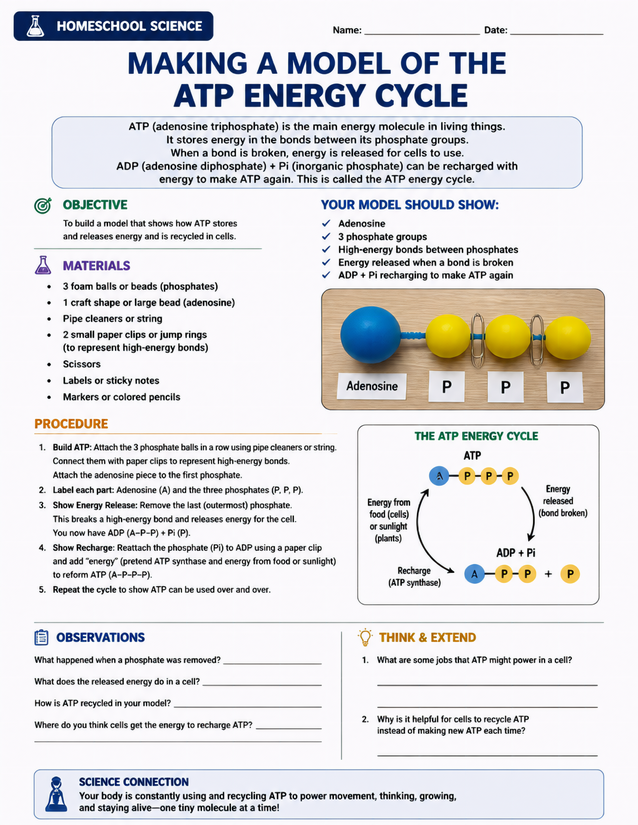
Foam balls and paper clips bring the ATP energy cycle model lab sheet to life for grades 6-8 homeschoolers. Instant download.
Investigating the ATP Energy Cycle Model Lab Sheet Step by Step

Usage Notes
Foam balls or large beads, pipe cleaners or string, paper clips or jump rings, scissors, and sticky notes are all household or craft-bin items. No specialty supplies are needed. Scissors are the only tool with a safety consideration, so younger students may want adult help during the cutting steps.

Printing Tips
A 24 lb copy paper weight holds up well here since students write observation answers during the activity rather than working on a wet or messy surface. Slip the sheet into a plastic page protector in a lab notebook, or keep it loose on a clipboard beside the model while students assemble and disassemble the phosphate chain.