Creative Minds 𖹭 Happy Hearts

Carbon Cycle Model Lab Sheet, Shoebox Diorama Activity
A shoebox becomes a working carbon cycle model lab sheet activity when your student adds cotton ball clouds, construction paper soil, and labeled arrows tracing how carbon moves between plants, animals, ocean, and rocks.
Designed for grades 4-7, this carbon cycle model lab sheet walks your student through building a physical diorama that maps carbon movement across Earth’s major systems. The seven-step procedure directs them to line a shoebox with brown and blue paper for soil and water, add rocks and a small plant, place cotton balls along the top to represent the atmosphere, and then connect each labeled component with directional arrows showing how carbon transfers during photosynthesis, animal consumption, decomposition, and ocean-atmosphere exchange. Three observation questions at the bottom ask students to describe how carbon moves in their model, explain why the cycle matters for life on Earth, and identify which part of the cycle surprised them most.
This carbon cycle model lab sheet fits naturally into an earth science or life science unit study and works as a standalone project or as a capstone activity after reading-based lessons on biogeochemical cycles. Because the model is three-dimensional and student-assembled, it moves beyond worksheet recall and asks your homeschooler to make spatial decisions about how each component connects to the others. Completing it demonstrates understanding of carbon as a shared element across living organisms, the atmosphere, oceans, soil, and geologic formations.
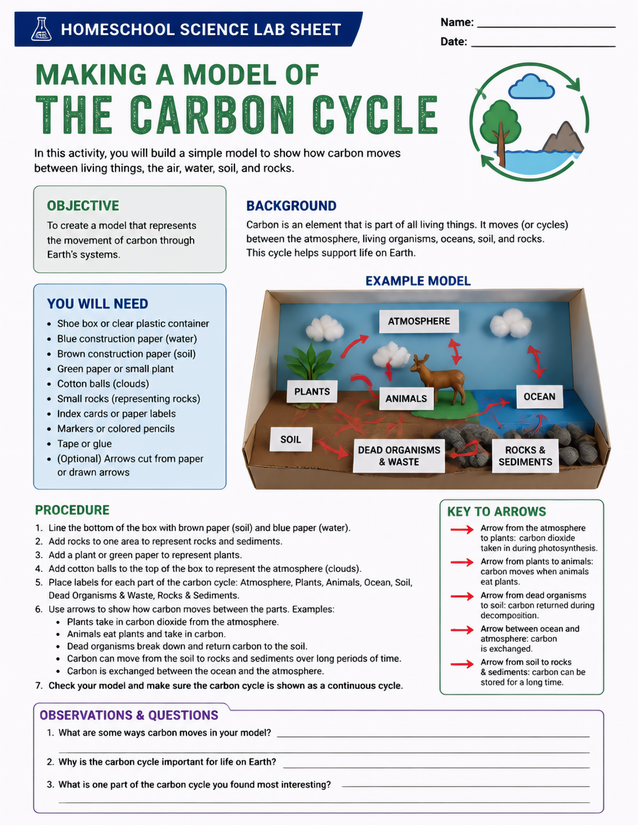
Build a carbon cycle model lab sheet diorama using household materials. Grades 4-7 homeschool science activity with labeled arrows and observation questions.
Investigating the Carbon Cycle Model Lab Sheet with a Shoebox Diorama

Usage Notes
Nearly every material on the list is a household staple: a shoebox or clear plastic container, blue and brown construction paper, cotton balls, small rocks, and tape or glue. A small plant or green paper substitutes for living vegetation. The only specialty items are optional, pre-cut paper arrows, though hand-drawn arrows work just as well. No safety considerations are implied beyond standard craft supply use.

Printing Tips
Cardstock at 65 lb holds up better than copy paper when students are cutting, gluing, and referencing the sheet beside a wet or messy diorama build. Keep it as a loose reference sheet on the work surface rather than inserting it into a notebook until the model is dry and the observation questions are filled in.