Creative Minds 𖹭 Happy Hearts

Making a Model of the Greenhouse Effect with a Glass Jar
A desk lamp stands in for the Sun, and two glass jars tell the whole story. Your student builds a working model of the greenhouse effect using materials already in your kitchen.
This lab sheet guides grades 4 to 6 homeschoolers through a temperature comparison experiment that answers one direct question: how does trapped heat behave differently from open air? Students place a thermometer inside each of two identical glass jars, label one CONTROL and one GREENHOUSE, cap the second jar, and then record the temperature difference every two minutes for twenty minutes under a lamp. The data table has eleven time intervals printed and ready, so your student focuses on observation rather than setup.
The model of the greenhouse effect maps cleanly onto Earth and Space Science units, particularly any sequence covering climate, atmosphere, or energy transfer. It works as a standalone lab or as a hands-on anchor for a broader unit study on Earth’s climate systems. By the conclusion section, your homeschooler connects the jar experiment directly to how Earth’s atmosphere traps heat, and the Think Further prompt at the bottom pushes toward real-world application.
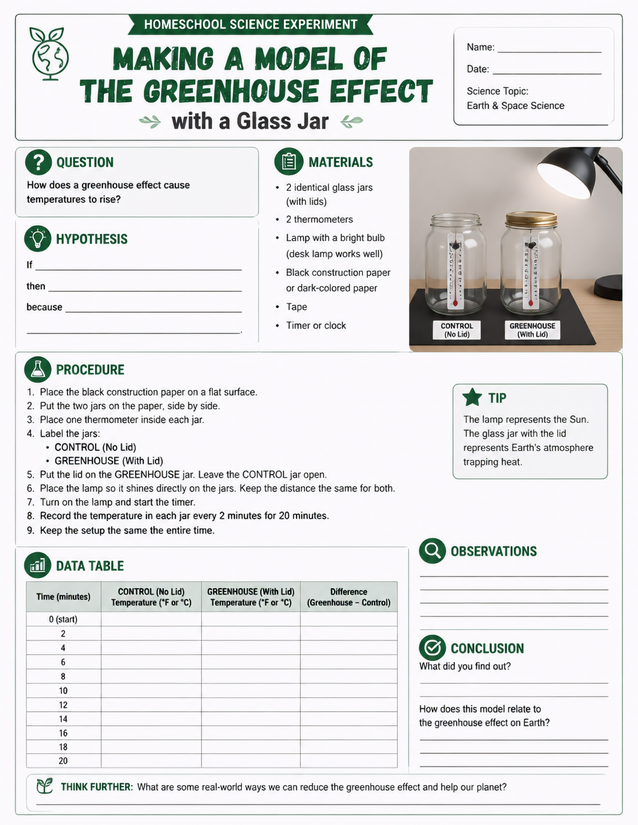
Two glass jars and a desk lamp let your student build a model of the greenhouse effect in grades 4-6. Download and print instantly.
Investigating a Model of the Greenhouse Effect Step by Step

Usage Notes
All materials listed on the sheet are household items: two glass jars with lids, two thermometers, a desk lamp, black construction paper, tape, and a timer. No specialty supplies are needed. The lamp gets warm during the 20-minute run, so remind your student to handle the bulb area carefully and not to touch the glass directly.

Printing Tips
Standard copy paper works fine for a single-use lab session, but 24 lb paper holds up better if your student writes while the sheet is on a clipboard next to the lamp. Slide the completed sheet into a science lab notebook after the experiment; the data table columns are narrow enough that laminating for reuse is not practical here.