Creative Minds 𖹭 Happy Hearts

Making a Model of the Human Cardiovascular System
Red water travels through clear tubing, past a bottle heart and into a bottle lung, making the model of the human cardiovascular system impossible to forget once your student pumps it to life.
Suited for grades 4 through 8, this lab sheet walks your student through constructing a closed-loop cardiovascular model using two 500 mL plastic bottles, clear plastic tubing, Y-connectors, red food coloring, and a large syringe or hand pump. The seven numbered steps guide them from filling the heart bottle one-third full with colored water to sealing every connection with modeling clay or tape, then pumping the system and watching the red water circuit through the lungs, split into the body branches, and return to the heart. A materials list, an objective statement, a reference diagram labeling the heart, lungs, and body connections, and a Did You Know fact about daily blood volume are all printed on the same sheet.
The model of the human cardiovascular system pairs naturally with a circulatory system unit study or a broader human body sequence, sitting well after lessons on the heart’s chambers and before lab work on pulse and blood pressure. A What Happened section asks your student to describe in two to three sentences what they observed when they pumped the system, and five Think and Reflect questions push them to compare the model to the real system, identifying what each component represents and where the model falls short. Completing the sheet demonstrates understanding of blood flow direction, the role of the lungs as a circuit stop, and the difference between pulmonary and systemic circulation.
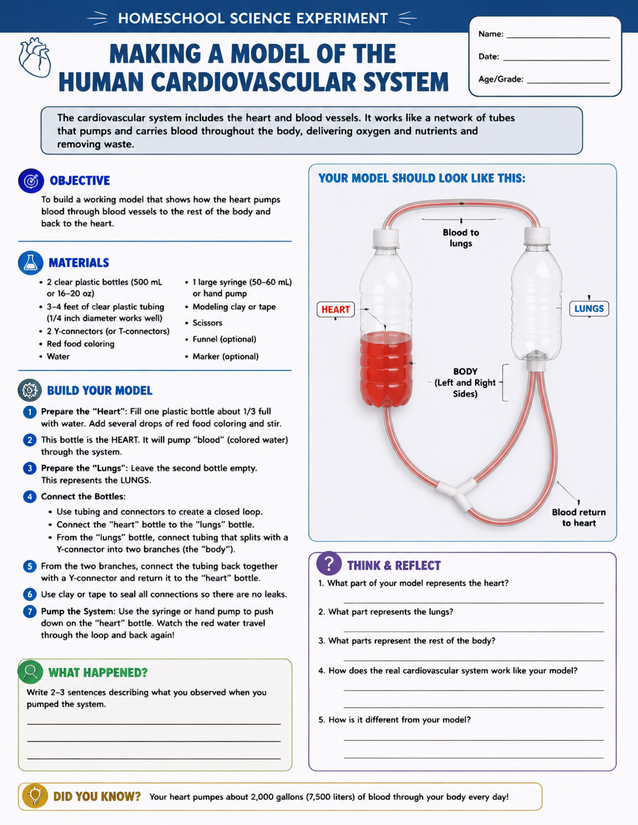
Red-colored water, plastic bottles, and tubing bring the model of the human cardiovascular system to life for grades 4-8 homeschoolers. Instant download.
Getting Started with Your Model of the Human Cardiovascular System

Usage Notes
Nearly every material on this list is a household or grocery-store find: plastic bottles, red food coloring, water, scissors, and tape are already in most homes. The specialty items are clear plastic tubing (1/4 inch diameter) and two Y-connectors or T-connectors, available at hardware stores for under a few dollars. Modeling clay seals the connections, so supervise younger students with scissors and remind them to keep the colored water away from fabric.

Printing Tips
A single sheet on 24 lb copy paper is enough for recording the written responses after the model is built. If your student will be handling wet bottles and tubing while writing, consider slipping the printed sheet into a plastic page protector or placing it on a clipboard set away from the workspace.