Creative Minds 𖹭 Happy Hearts

Making a Model of the Human Ear and Studying Sound Wave Transmission
Balloons, a paper plate, and a plastic funnel come together in making a model of the human ear that actually vibrates when sound hits it. Your student can watch the ossicles move.
Making a model of the human ear guides students in grades 4 to 6 through building each anatomical section from common household materials. The sheet walks through six numbered steps covering the pinna, ear canal, eardrum, ossicles, and cochlea, then asks students to record what visibly happens to each part when a sound source is placed nearby. Observation prompts target the balloon eardrum, the craft stick ossicles, and the bead-filled cochlea balloon separately, so your student writes a distinct response for each structure rather than a single general answer.
This lab fits naturally into a human body unit study or a sound and waves unit in middle school science. It works as a standalone hands-on lesson or as the anchor activity before moving into lessons on hearing loss or auditory anatomy. Completing the sheet demonstrates that your homeschooler can connect a physical model to biological function and explain sound transmission in sequence from outer ear to inner ear.
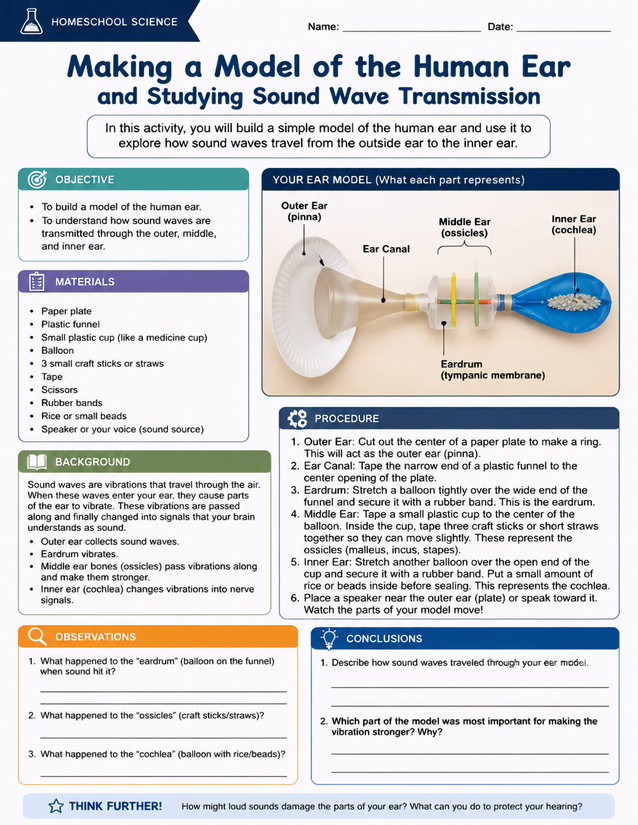
Grades 4-6 homeschoolers investigate making a model of the human ear using everyday household materials to explore sound wave transmission.
Investigating Making a Model of the Human Ear Step by Step

Usage Notes
All materials listed are standard household or craft supplies: a paper plate, plastic funnel, small plastic cup, two balloons, craft sticks or straws, tape, scissors, rubber bands, and rice or small beads. No specialty science supplies are required. Scissors are the only tool that warrants supervision for younger students, and the rubber bands need to be stretched tightly over the funnel, so adult help may be needed at that step.
Printing Tips
Twenty-pound copy paper works for the observation and conclusions sections, but if your student will be handling the sheet near a speaker or while assembling the model, 24 lb paper holds up better with damp hands. Punch and insert into a science lab notebook after the experiment so the recorded results stay with any follow-up notes on hearing or sound waves.