Creative Minds 𖹭 Happy Hearts

Making a Model of the Menstrual Cycle Hormones, 28-Day Clay Activity
Four hormones, four clay colors, one paper plate marked like a clock. Your student builds a model of the menstrual cycle hormones that makes rising and falling patterns visible at a glance.
Your student uses four colors of clay or playdough to represent FSH, LH, estrogen, and progesterone, placing clay pieces on a paper plate divided into 28 days to show when each hormone peaks and drops. The lab sheet walks through a seven-step procedure, a reference chart for hormone levels, and a data table where your student records when each hormone is highest, when it is lowest, what it does in the cycle, and observations from the finished model. This hands-on activity suits grades 6-9 and pairs naturally with a unit study on human body systems or reproductive biology.
Building a model of the menstrual cycle hormones this way turns an abstract topic into something your student can physically arrange, compare, and discuss. The reflection questions on the sheet push beyond the model itself, asking which hormone spiked mid-cycle, which stayed elevated in the second half, and why hormone levels fluctuate at all. A student who completes the full sheet demonstrates both procedural understanding of how hormones interact and analytical thinking about pattern recognition in biological systems.
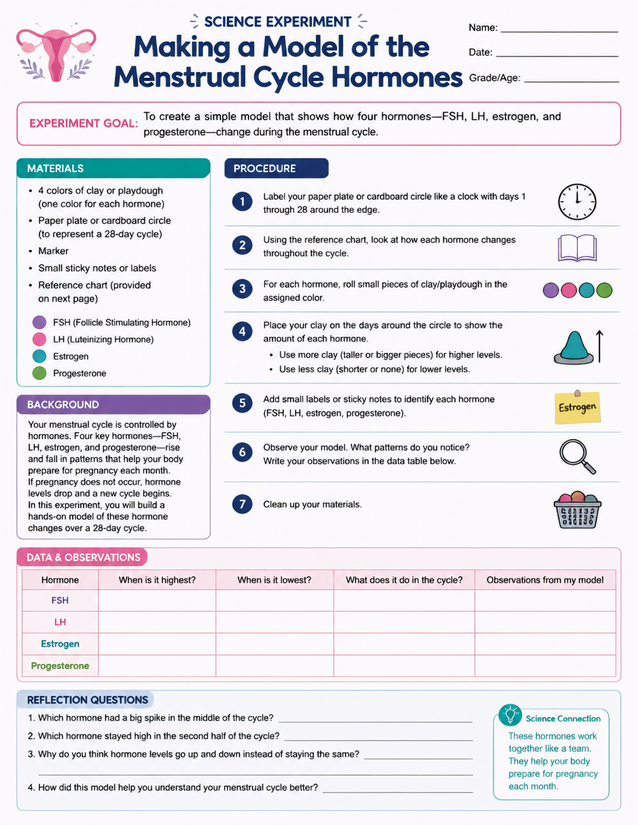
Grades 6-9 homeschoolers build a model of the menstrual cycle hormones using clay and a paper plate cycle chart.
Recording Results for Your Model of the Menstrual Cycle Hormones

Usage Notes
Clay or playdough in four distinct colors is the main supply, and most households already have one or two. A paper plate or cardboard circle, a marker, and small sticky notes round out the list, all household items. No heat, chemicals, or specialty tools are involved, making setup straightforward for an at-home lab session.

Printing Tips
Cardstock at 65-80 lb gives the data table enough weight to hold up under writing without buckling on a clipboard. Loose sheets work well here since the model sits separately on the plate, keeping the recording sheet clean and easy to tuck into a science binder afterward.