Creative Minds 𖹭 Happy Hearts

Synaptic Junction Model Lab Sheet, Foam Balls and Clay
Neurons never actually touch, and that gap is the whole story. This synaptic junction model lab sheet turns an abstract biology concept into something your student can hold, label, and explain.
Designed for grades 7-10, this synaptic junction model lab sheet walks your student through building a three-dimensional synapse using foam balls, small beads or pom-poms, modeling clay, and a zip-top bag to represent the synaptic cleft. The six-step procedure guides them from forming the presynaptic neuron to placing neurotransmitter beads in the gap and adding clay receptors on the postsynaptic side, with a hypothesis section completed before building begins and a labeled diagram on the sheet for reference.
As a standalone neuroscience activity or a hands-on addition to a biology or anatomy unit study, the synaptic junction model lab sheet asks your student to record observations about how each part functions together and write a conclusion explaining what happens when a signal travels from one neuron to another. A Think Further prompt extends the lesson by asking what would happen if neurotransmitters were not released or receptors stopped working, making this a strong fit for Charlotte Mason-style narration or a Socratic discussion close.
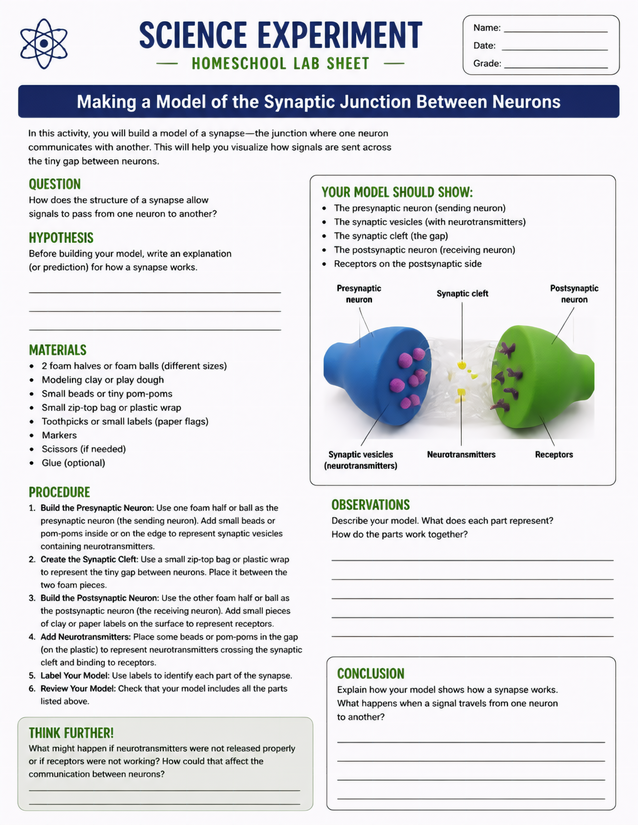
Build and label a synaptic junction model lab sheet covering grades 7-10 neuroscience. Foam balls, beads, and clay make every part visible.
Setting Up Your Synaptic Junction Model Lab Sheet

Usage Notes
Foam halves or balls in two sizes anchor the build, and the sheet specifies small beads or pom-poms for neurotransmitter vesicles and modeling clay or play dough for receptors. A zip-top bag stands in for the synaptic cleft, so nearly everything here is a household or dollar-store supply. Scissors and glue are listed as optional, and no heat or chemicals are involved, making this a safe, mess-manageable lab for home.

Printing Tips
A single loose sheet on a clipboard works well here since students write a hypothesis before building and return to the sheet for observations mid-project. Standard 20-lb copy paper is fine, but 24-lb holds up better if the sheet gets handled repeatedly between build steps.