Creative Minds 𖹭 Happy Hearts

Making a Model Showing How the Heart Pumps Blood
Pull the bottom balloon down and watch red water rise through the straws. That one motion is the whole heart explained, and this model showing how the heart pumps blood makes it impossible to forget.
Your student builds a working heart model from a plastic bottle, two balloons, four straws, red-dyed water, and clay or putty, materials most households already have. The sheet walks through eight numbered steps, from cutting the bottle bottom to sealing the straws airtight, then asks students to observe and record what happens when the diaphragm balloon is pulled down and released. A conclusion prompt asks students to explain in writing how the model demonstrates circulation, making this a strong fit for grades 4-7 life science.
For a unit study on the circulatory or cardiovascular system, this model showing how the heart pumps blood gives your homeschooler a physical, pressure-based explanation of why blood moves in one direction. A “Think Further” question at the bottom pushes critical thinking beyond the model itself, asking how valves keep blood flowing one way. It works equally well as a standalone hands-on lesson or as the anchor activity in a longer body systems sequence.
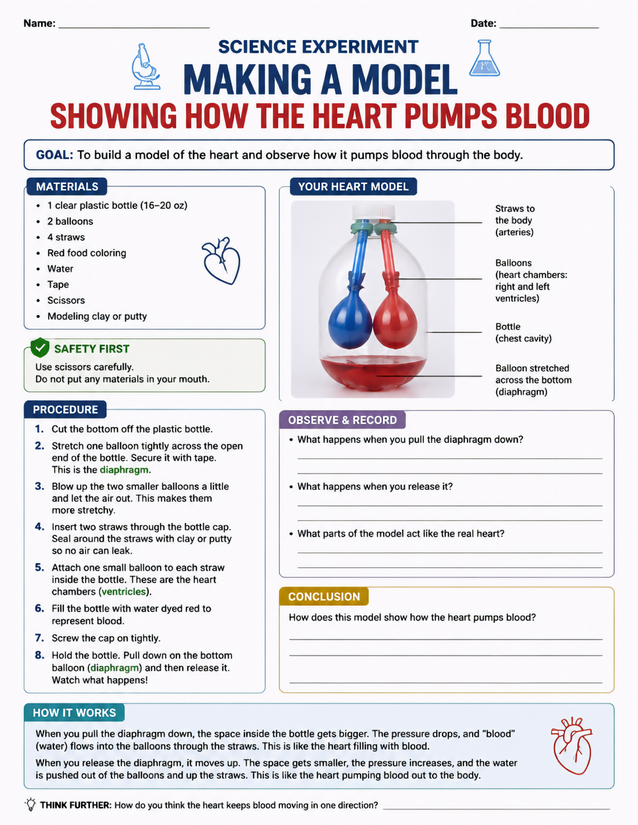
Grades 4-7 homeschoolers build a model showing how the heart pumps blood using balloons, straws, and a plastic bottle.
Getting Started with Your Model Showing How the Heart Pumps Blood

Usage Notes
Nearly everything on the materials list is a household item: a clear plastic bottle (16-20 oz), two balloons, four straws, red food coloring, water, tape, scissors, and modeling clay or putty. Scissors are the only tool that warrants caution, and the sheet flags this explicitly in a Safety First note. The clay or putty is used to create an airtight seal around the straws at the bottle cap, so a firmer putty works better than a loose dough.
Printing Tips
A 24-lb or heavier copy paper handles the writing load in the observe-and-record and conclusion sections without buckling under pen pressure. Loose sheets on a clipboard work well here since students are actively handling a wet, dye-filled bottle and need the sheet nearby but dry.