Creative Minds 𖹭 Happy Hearts

Making a Model Showing How Vaccines Work in the Immune System
Pom-poms standing in for germs and pipe-cleaner antibodies make how vaccines work in the immune system something your student can actually hold in their hands and walk through step by step.
Your student builds a four-part physical model to demonstrate how vaccines work in the immune system, using colored pom-poms as germs and Y-shaped pieces as antibodies placed inside a small cup representing the body. Each step mirrors a real biological sequence: the inactive vaccine enters, antibodies form, the real germ arrives, and the immune system neutralizes it. The sheet includes a Key Idea section, labeled material diagrams, and an optional sticky-note labeling activity, making it well-suited for grades 4-7.
This lab fits naturally into an immunology or human body unit study, and it works as a standalone lesson before introducing vaccines through reading or documentary. A completed sheet, including the Think and Discuss questions and the What I Learned summary, shows that your homeschooler can trace the immune response sequence and explain why prior exposure to an inactive germ creates lasting protection.
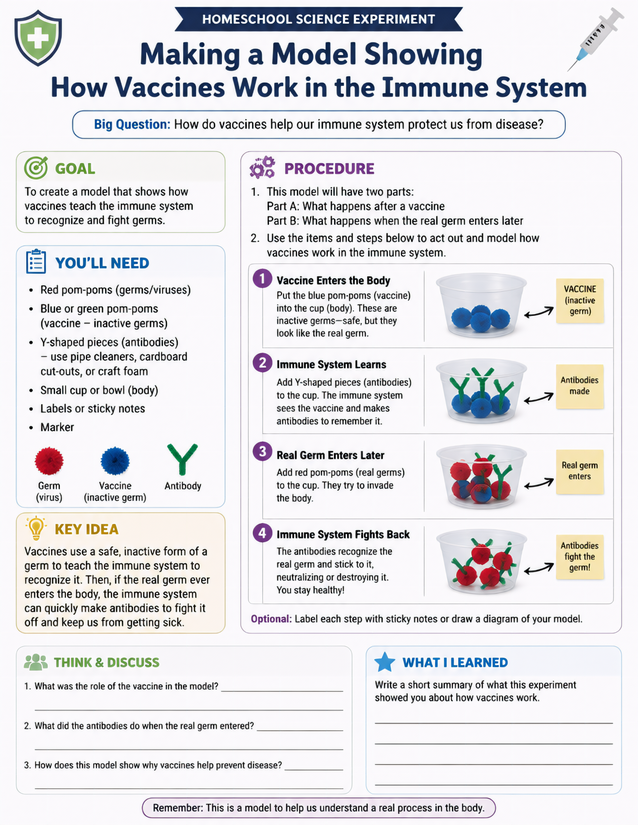
Red and blue pom-poms demonstrate how vaccines work in the immune system in this hands-on grades 4-7 homeschool experiment.
Exploring How Vaccines Work in the Immune System with Pom-Poms

Usage Notes
Red pom-poms, blue or green pom-poms, Y-shaped pieces made from pipe cleaners or cardboard cutouts, a small cup or bowl, sticky notes, and a marker are all that is needed here. Every material on the list is a household or craft-bin staple, so no specialty supply run is required. No heat, chemicals, or sharp tools are involved, making independent setup straightforward for most upper-elementary students.

Printing Tips
Standard copy paper holds up fine for desk use, but 24-lb paper takes pen or pencil in the Think and Discuss lines without ghosting through to the back. Slip the printed sheet into a clear page protector in your student’s science binder so it stays readable while they handle the pom-pom materials alongside it.