Creative Minds 𖹭 Happy Hearts

Making a Simple Sundial and Calibrating It, Homeschool Lab Sheet
Shadow marks on a paper plate, made every hour on a sunny day, add up to a working clock. Making a simple sundial and calibrating it teaches your student how ancient timekeeping actually worked.
Making a simple sundial and calibrating it is the focus of this two-part lab sheet, designed for grades 3 through 6. Part one walks students through poking a hole in a paper plate or cardstock circle, inserting a pencil upright as the gnomon, marking the noon line, and setting the structure on a level surface outdoors. Part two covers calibration: students place the sundial in full sun, align the noon line toward the sun, and then mark the tip of the pencil’s shadow on the hour every hour from morning into late afternoon. An observations section at the bottom asks what worked well, what challenges came up, and how accurate the sundial proved to be.
This lab sheet fits naturally into a unit study on Earth science, astronomy, or the history of measurement, and it connects well to lessons on the Sun’s apparent east-to-west movement across the sky. A science connection box on the sheet explains that Earth’s rotation causes that apparent movement, giving your homeschooler a concrete bridge between the hands-on build and the underlying concept. Completing the calibration portion across a single full sunny day demonstrates that your student can observe, record time-stamped data, and draw conclusions from results, skills that build directly toward more formal experimental design.
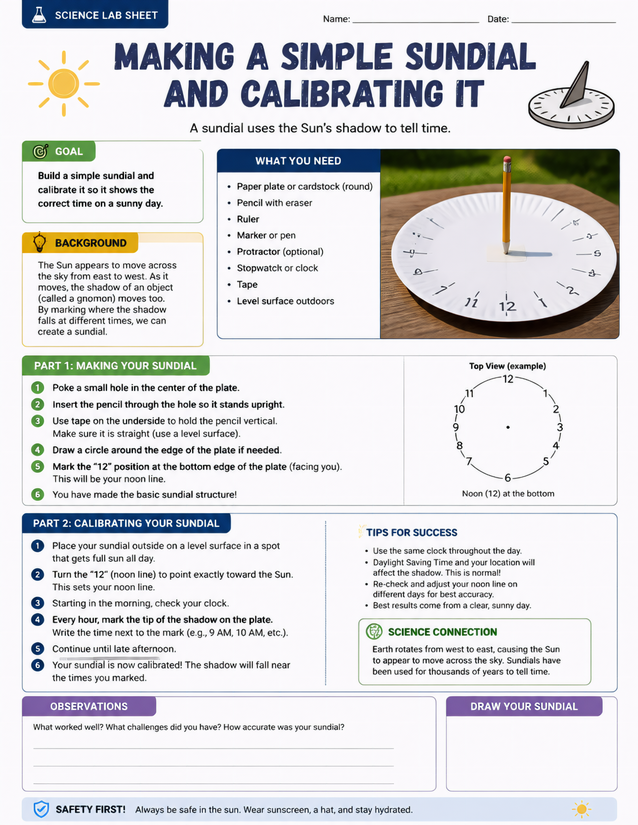
Grades 3-6 homeschoolers learn timekeeping by making a simple sundial and calibrating it using shadow marks throughout a sunny day.
Getting Started with Making a Simple Sundial and Calibrating It

Usage Notes
Nearly everything on the materials list is a household staple: a paper plate or round piece of cardstock, a pencil with an eraser, a ruler, a marker or pen, tape, and a stopwatch or clock. A protractor is listed as optional for students who want to space hour lines mathematically. The sheet includes a safety note reminding students to wear sunscreen, a hat, and stay hydrated, since calibration requires repeated trips outdoors throughout the day.

Printing Tips
Card stock at 65 lb or heavier holds up better than copy paper here, since the sheet may travel outside multiple times during the calibration phase. A loose sheet on a clipboard works well so students can carry it to the sundial, mark the shadow tip, and return it inside without the paper warping in the sun.