Creative Minds 𖹭 Happy Hearts

Solar Powered Irrigation System Model Lab Sheet
Sunlight pumps water onto seedlings in this solar powered irrigation system model, turning a small solar panel, a DC pump, and clear tubing into a working drip system your student assembles from scratch.
Your student builds a functional drip irrigation model powered entirely by a 6V solar panel connected to a DC water pump. The sheet walks through nine numbered steps, from constructing a cardboard base and setting up a water source to connecting alligator clip wires, positioning the drip line over a soil tray, and testing the pump in direct sunlight. An observations table captures time, sunlight condition, pump status, and whether water is dripping, giving your homeschooler structured data collection practice. Five Think and Reflect questions ask your student to compare sun versus shade performance, evaluate water-saving benefits, and propose improvements to their own design. This solar powered irrigation system model is suited for grades 4-7 and sits at the intersection of physical science, environmental science, and engineering design.
The lab works well as a standalone project or as an anchor activity inside a renewable energy unit study. Paired with lessons on circuits or photosynthesis, it lets your student see how solar electricity converts to mechanical work and then to plant support. Completing the sheet demonstrates understanding of energy conversion, basic circuit connections, and the real-world application of drip irrigation, and the eco tip at the bottom opens a natural conversation about sustainable agriculture.
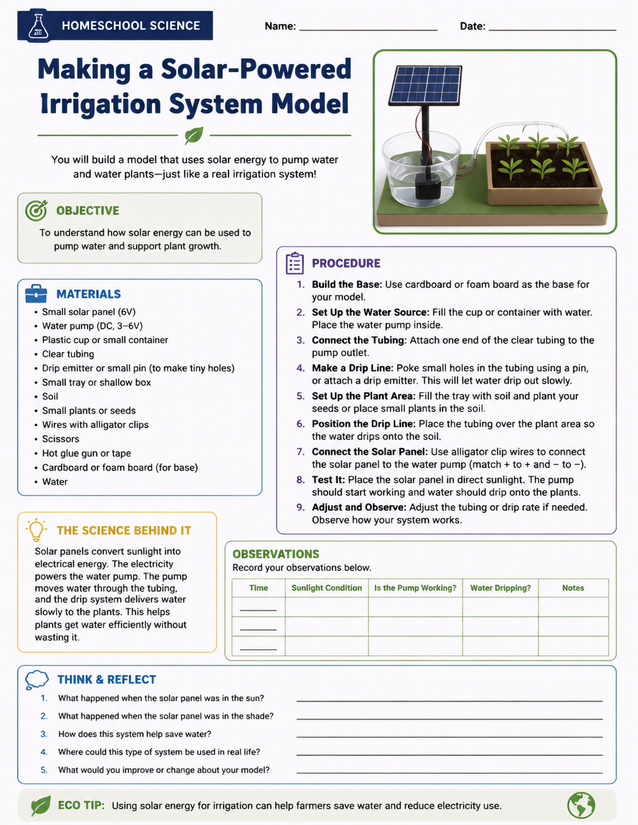
Build a solar powered irrigation system model using real components. Ideal for grades 4-7 homeschoolers studying renewable energy and plant science.
Recording Results for Your Solar Powered Irrigation System Model

Usage Notes
Several materials here are specialty items you may need to source ahead of time: a 6V small solar panel and a DC 3-6V water pump are not typical household supplies, though they are inexpensive and widely available online. Clear tubing, alligator clip wires, a plastic cup, soil, and cardboard or foam board are the remaining items, most of which are easy to gather at home. The wiring step connects the solar panel directly to the pump, so supervise younger students during that stage and confirm polarity matches before placing the panel in sunlight.

Printing Tips
Twenty-four-pound paper gives the observations table enough body to write on during the experiment without the sheet buckling when it gets near water. A loose sheet on a clipboard works best here since your student will be moving between the water source, the plant tray, and direct sunlight during testing.