Creative Minds 𖹭 Happy Hearts

Making a Solar-Powered Vehicle Lab Sheet
Four wheels, a DC motor, and direct sunlight are all your student needs. Making a solar-powered vehicle turns an energy conversion lesson into something that actually rolls across the driveway.
Making a solar-powered vehicle anchors a renewable energy unit for grades 4 through 7, walking students through the full build and test sequence on one sheet. The overview explains how solar panels convert sunlight into electricity and how that electricity drives a DC motor to produce motion. Students record observations across four test conditions, including direct sunlight, partial shade, indoor room light, and a cloudy day, tracking whether the vehicle moved and how far it traveled.
The sheet works well as a standalone hands-on learning project or as the engineering capstone of a broader energy unit study. Completing it asks your student to explain the energy source, account for variables that slowed the vehicle, propose design improvements, and connect solar transportation to real-world applications. A challenge section invites faster builds using lighter materials or different gear sizes, and a Go Green note reinforces why solar energy matters beyond the experiment itself.
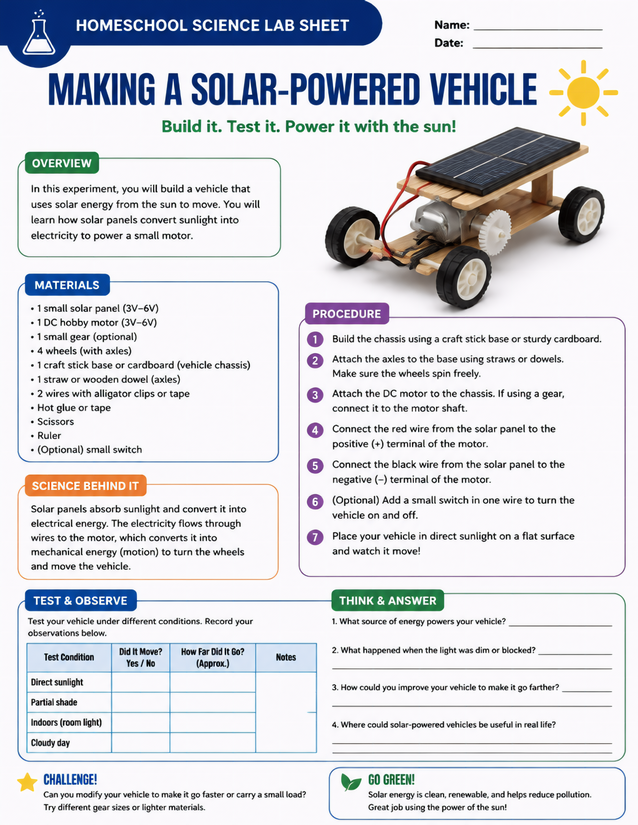
Grades 4-7 homeschoolers build and test making a solar-powered vehicle using a DC motor, solar panel, and craft materials.
Investigating with Making a Solar-Powered Vehicle in Your Homeschool Lab

Usage Notes
Craft sticks, cardboard, straws, tape, and a ruler are household staples most families already own. The specialty items, a small solar panel rated 3V to 6V and a DC hobby motor in the same voltage range, are widely available in basic electronics kits or online for a few dollars. Wiring the motor terminals to the solar panel involves exposed wire and alligator clips, so supervise younger students when connecting the circuit.

Printing Tips
Twenty-four-pound paper gives the Test and Observe table enough body to write on during an outdoor test session without buckling on a clipboard. Slip the sheet into a plastic page protector if your student is working near a water source or in unpredictable weather, and record results in pencil first.