Creative Minds 𖹭 Happy Hearts

Making a Thermometer with Alcohol in a Straw
Rubbing alcohol rising in a straw tells your student everything they need to know about thermal expansion. Making a thermometer with alcohol in a straw turns that principle into a hands-on measurement they built themselves.
This lab sheet guides your student through building a functional thermometer from a clear plastic bottle, a straw, rubbing alcohol, food coloring, and modeling clay. Students write two hypothesis statements, then follow seven numbered steps to seal the straw airtight, mark a Celsius scale from -10 to 50 degrees, and test the device in three environments: ice water, room temperature, and warm water. Designed for grades 3-5, the sheet connects directly to heat transfer and states of matter units in a homeschool science curriculum.
Making a thermometer with alcohol in a straw gives your homeschooler a concrete demonstration of why commercial thermometers work, rather than simply telling them. The observations table asks students to record both an estimated temperature and the corresponding alcohol level on their straw scale for each environment, building data-recording habits alongside the science concept. A conclusion section asks what they learned and whether their hypothesis proved correct, completing the full scientific method cycle in a single standalone lab session or as part of a broader physics or chemistry unit study.
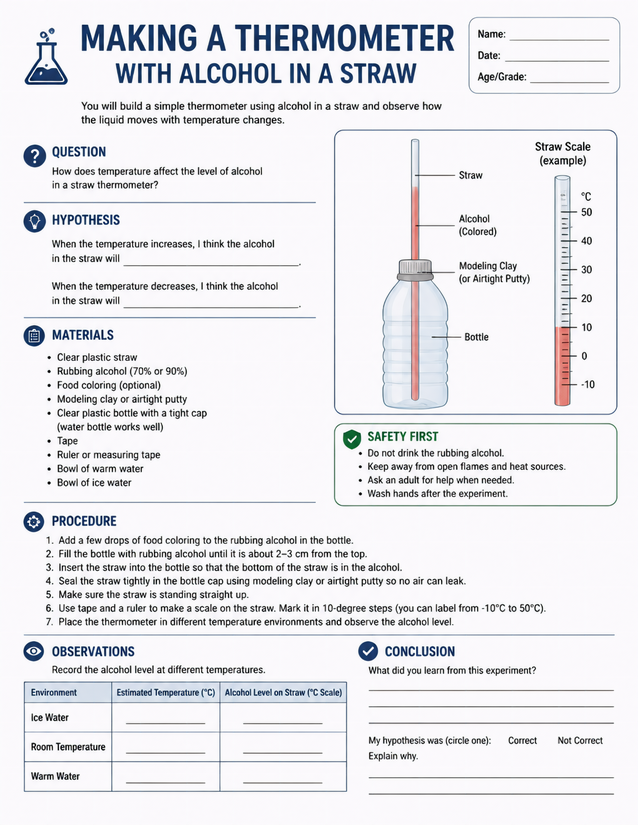
Grades 3-5 homeschoolers learn temperature science by making a thermometer with alcohol in a straw using everyday household materials.
Investigating with Making a Thermometer with Alcohol in a Straw

Usage Notes
Rubbing alcohol at 70 or 90 percent is a specialty pharmacy item, but everything else on the materials list is likely already in your home. Food coloring is listed as optional, though it makes the alcohol level far easier to read against the straw. The safety section flags the alcohol as a flammable liquid, so keep the experiment away from open flames and have an adult supervise when younger students are handling it.
Printing Tips
Twenty-four-pound paper gives students enough surface to press firmly while writing observations without the sheet buckling on a clipboard. A loose sheet works well here since students will be moving the thermometer between bowls of water, so skip the notebook binding for this one and let them clip it within easy reach of the experiment.