Creative Minds 𖹭 Happy Hearts

Making a Timeline of Evolution Using a Toilet Paper Roll
Billions of years of Earth’s history, mapped onto a toilet paper roll. Making a timeline of evolution turns an abstract concept into something your student can hold, draw on, and actually read.
Making a timeline of evolution anchors major events, from Earth’s formation 4.6 billion years ago through the appearance of early humans, in a sequence your student builds by hand. The lab sheet walks through eight steps: researching key events, ordering them from earliest to most recent, dividing the roll into labeled sections, illustrating each event, and adding a directional arrow showing time’s flow. A built-in reference table lists seven milestones with dates, so your student has a reliable starting point without additional prep from you. This suits grades 4-7 and works especially well inside an earth science or life science unit study.
The sheet fits naturally into a broader evolution or natural history sequence, but it also stands alone as a one-session lab that demonstrates chronological thinking alongside science content. A completed roll shows your student can organize events by scale, something that trips up many learners when numbers reach into the billions. The Think and Reflect section closes the lab with three written prompts asking your student to name a surprising event, explain how the timeline shows change over time, and record remaining questions, giving you a quick window into their comprehension.
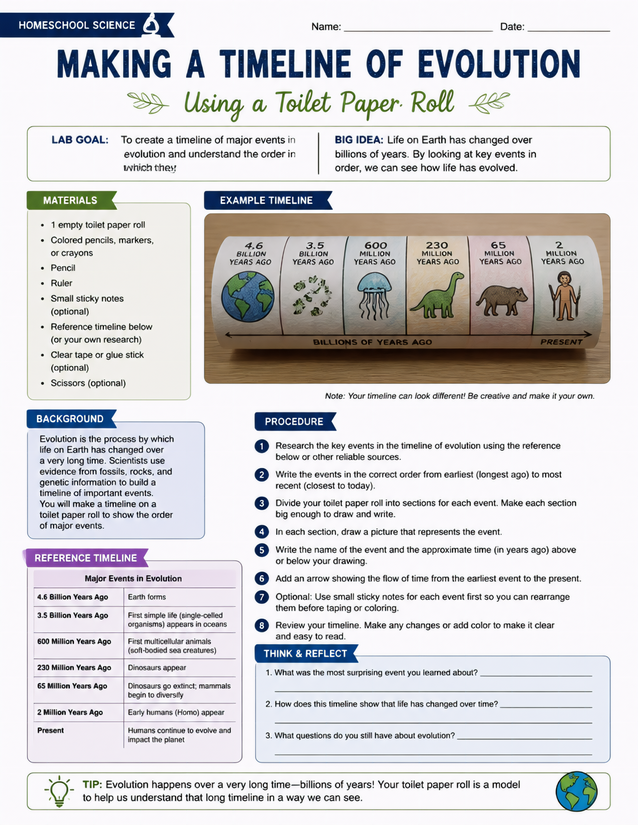
Grades 4-7 homeschoolers explore making a timeline of evolution using a toilet paper roll. Includes a reference timeline and Think and Reflect questions.
Exploring Making a Timeline of Evolution with Your Homeschooler

Usage Notes
Everything on the materials list is either already in your home or costs nothing: one empty toilet paper roll, colored pencils or markers, a pencil, a ruler, scissors, and optional sticky notes for drafting the sequence before committing to color. Clear tape or a glue stick rounds out the list if your student wants to attach extra paper sections. No specialty supplies are needed, and there are no safety considerations beyond standard scissor use.

Printing Tips
Standard copy paper works for the recording sheet itself, but print at full size so the reference timeline table stays legible. The sheet is meant to accompany the hands-on roll rather than replace it, so a loose page on a clipboard or tucked into a science notebook alongside the finished roll keeps everything together.