Creative Minds 𖹭 Happy Hearts

Making a Timeline of Geological Eras, Rope Activity
Rope stretched across the floor tells Earth’s 4.6-billion-year story better than any textbook diagram. Making a timeline of geological eras gives your student a physical sense of just how vast the Hadean and Archean really were.
Your student works through six geological eras, from the Hadean at 4,600 million years ago to the Cenozoic, which runs to the present. The sheet provides a color-coded reference table with approximate time ranges for each era, and the procedure walks students through laying out a rope proportionally so the length of each segment reflects how long that era actually lasted. Three follow-up questions ask which era lasted longest, which is most recent, and how the physical model improved their understanding of Earth’s history. This activity suits grades 4 through 7 and anchors making a timeline of geological eras squarely in hands-on learning rather than passive reading.
The rope timeline works well as a standalone activity or as the opening lesson in a unit study on Earth science, deep time, or historical geology. It pairs naturally with lessons on plate tectonics, fossil records, or major extinction events. By the time your homeschooler steps back and looks at the finished rope, they have demonstrated an ability to interpret proportional data, sequence events chronologically, and translate a numerical scale into a spatial model.
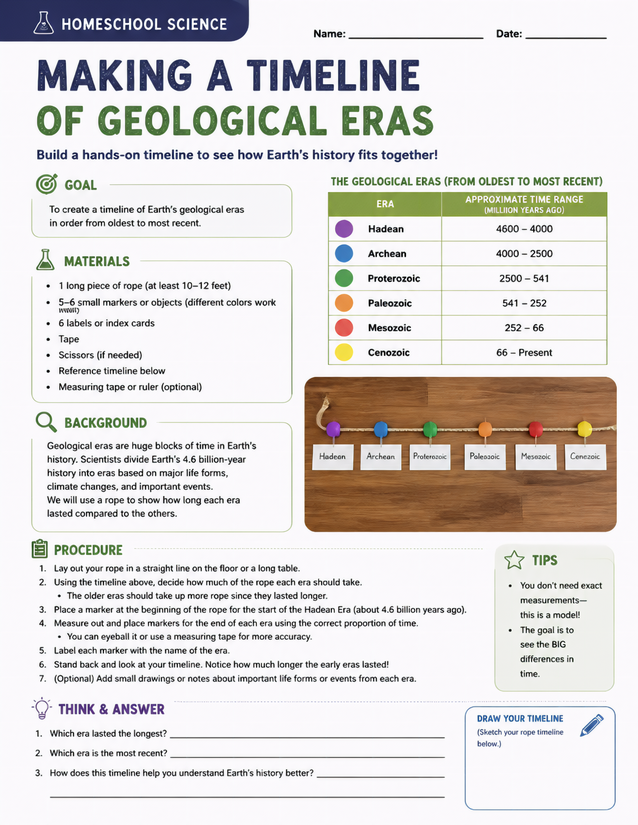
Grab rope and index cards to start making a timeline of geological eras, grades 4-7. All six eras covered.
Recording Results for Making a Timeline of Geological Eras

Usage Notes
Nearly everything on the materials list is already in the house: a long piece of rope at least 10 to 12 feet, tape, scissors, and index cards or paper labels. The only item that might require a quick search is a measuring tape or ruler, listed as optional. No safety concerns are implied, though scissors use should be supervised for younger students.
Printing Tips
Standard copy paper is fine here since students write on index cards rather than directly on the sheet. Slip the printed lab page into a page protector inside your Earth science binder so the reference table stays visible while your student works on the floor with the rope.