Creative Minds 𖹭 Happy Hearts

Making a Volcano with Baking Soda and Vinegar, Lab Sheet
Baking soda meets vinegar, and suddenly your kitchen tray looks like Pompeii. Making a volcano with baking soda and vinegar is the experiment that gets reluctant scientists leaning in.
This lab sheet walks your student through the complete scientific method using one of the most satisfying chemical reactions in elementary science. The question is already printed at the top: what happens when baking soda and vinegar are mixed together? Your homeschooler fills in a hypothesis with an ‘I think / because’ sentence frame, follows six numbered procedure steps to build the clay volcano and trigger the eruption, then records observations including what they saw, the color of the lava, and how it smelled. An explanation section defines the acid-base reaction and introduces the concept of a chemical reaction, with one fill-in-the-blank to name the gas produced. Suited for grades 2 through 5, this sheet fits naturally into a chemistry unit or an earth science unit on volcanoes.
Making a volcano with baking soda and vinegar works as a standalone introduction to chemical reactions or as a hands-on anchor activity inside a larger unit study on acids and bases. A student who completes the full sheet demonstrates the ability to form a hypothesis, follow a multi-step procedure, make sensory observations, and evaluate their own prediction in the conclusion section. The Extend the Fun prompts at the bottom encourage your homeschooler to vary the amounts of each reactant and research real volcanoes, giving you an easy bridge into a second experiment day or a Charlotte Mason nature journal entry on geology.
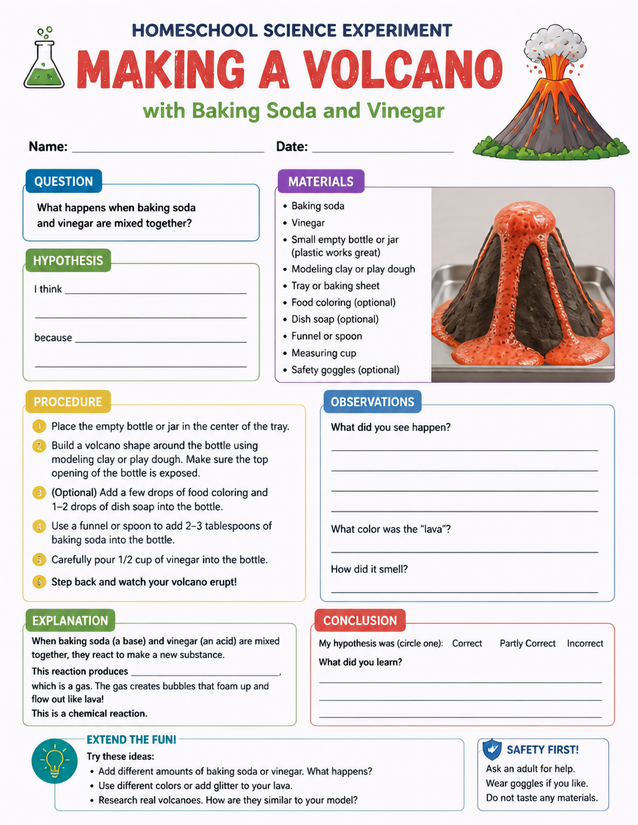
Grades 2-5 homeschoolers record the classic making a volcano with baking soda and vinegar chemical reaction on this structured lab sheet.
Investigating Making a Volcano with Baking Soda and Vinegar

Usage Notes
Nearly every item on the materials list is already in your kitchen or craft drawer: baking soda, vinegar, a small plastic bottle, modeling clay or play dough, a tray or baking sheet, and a measuring cup. Food coloring and dish soap are listed as optional additions that make the eruption more dramatic. Safety goggles are also noted as optional, but worth having on hand since vinegar can splash during the reaction.

Printing Tips
Standard copy paper handles a single-session experiment like this without any trouble. Slide the completed sheet into a three-ring binder or a dedicated science lab notebook so your student can revisit it when you cover acids and bases at a higher level later.