Creative Minds 𖹭 Happy Hearts

Making a Water Wheel and Measuring Its Power Output
Cardboard paddles, a wooden dowel, and flowing water are all it takes to put the Power (W) = Work (J) / Time (s) formula to a real test. This making a water wheel lab sheet walks your student through building, loading, and calculating across three timed trials.
Your student builds a paddle wheel, mounts it on an axle over a tray, and lets a directed water source spin it while it lifts a known mass on a string. The making a water wheel lab sheet records mass in kilograms, height lifted in meters, time in seconds, work in joules, and power in watts across three trials, making it a strong fit for grades 5-8 studying simple machines and energy transfer. The sheet also provides the full calculation sequence, Force (N) = mass x 9.8, Work (J) = force x distance, Power (W) = work divided by time, so your student shows every step rather than just filling in a final number.
This experiment works well as a standalone unit study session or as the applied measurement component of a broader simple machines or renewable energy unit. Three reflection questions ask your homeschooler to analyze what affected power output most, predict how increasing flow rate would change results, and propose design improvements, skills that align with middle school scientific reasoning benchmarks. Completing all three trials and the calculations demonstrates that your student can apply formula chains to physical data collected during hands-on learning.
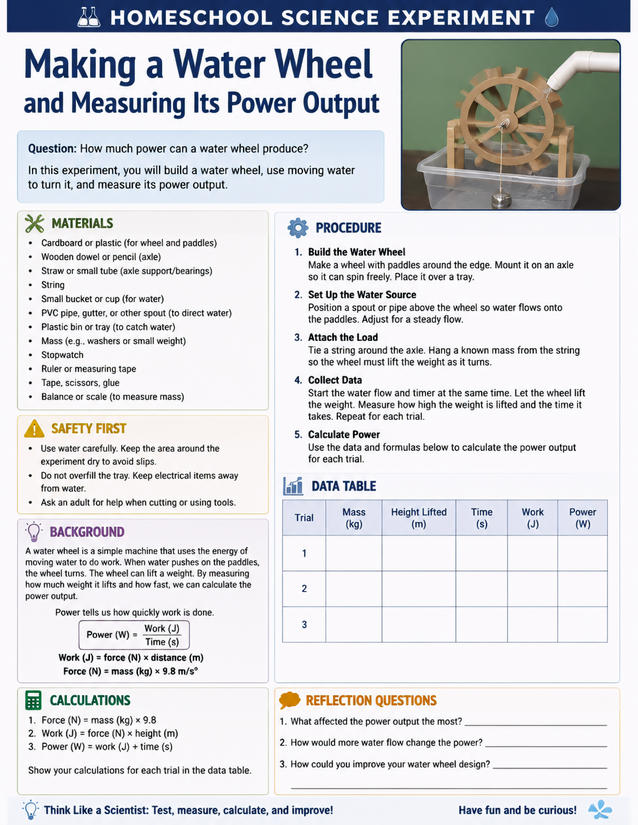
Grades 5-8 homeschoolers calculate real power output using this making a water wheel lab sheet. Three timed trials included.
Getting Started with Your Making a Water Wheel Lab Sheet

Usage Notes
Cardboard or plastic for the wheel, a wooden dowel or pencil, straw segments, string, a small cup or bucket, and washers for the hanging mass are all household items. The PVC pipe or gutter listed for directing water flow may require a quick trip to a hardware store, though a bent plastic bottle works as a substitute. Water near electrical items is the main safety concern the sheet flags explicitly, so set up on a surface where spills stay contained in the plastic bin.

Printing Tips
Twenty-four-pound copy paper gives students enough surface stability to write force and power calculations in the data table while the sheet sits on a clipboard next to a wet tray. Slip the completed sheet into a lab notebook alongside any photos of the build for a clean unit study record.