Creative Minds 𖹭 Happy Hearts

Making Homemade Soap and Testing Its pH
Glycerin goes into the microwave, fragrance goes in the mold, and pH test strips settle the question: making homemade soap and testing its pH turns a craft into a real chemistry experiment.
This two-part lab sheet walks your student through a melt-and-pour method for making soap from a glycerin base, then immediately pivots to chemistry by testing the finished bar with pH strips and distilled water. The results table asks your homeschooler to record readings for homemade soap, a store-bought comparison bar, and a plain water control, then interpret where each falls on the 0 to 14 scale. Suited for grades 4 through 7, the sheet includes a Did You Know panel explaining why soap typically reads between 8 and 10 on the pH scale, which gives your student a target to check their own result against.
Four reflection questions push beyond recording numbers: your student explains what the pH reading means for how soap actually cleans, compares results to the commercial bar, and identifies what they would change in a follow-up trial. Making homemade soap and testing its pH works well as a standalone hands-on lesson or as the chemistry component inside a larger matter-and-mixtures unit study. By the end, your homeschooler has made something tangible, read a scientific instrument, and drawn a conclusion grounded in their own data.
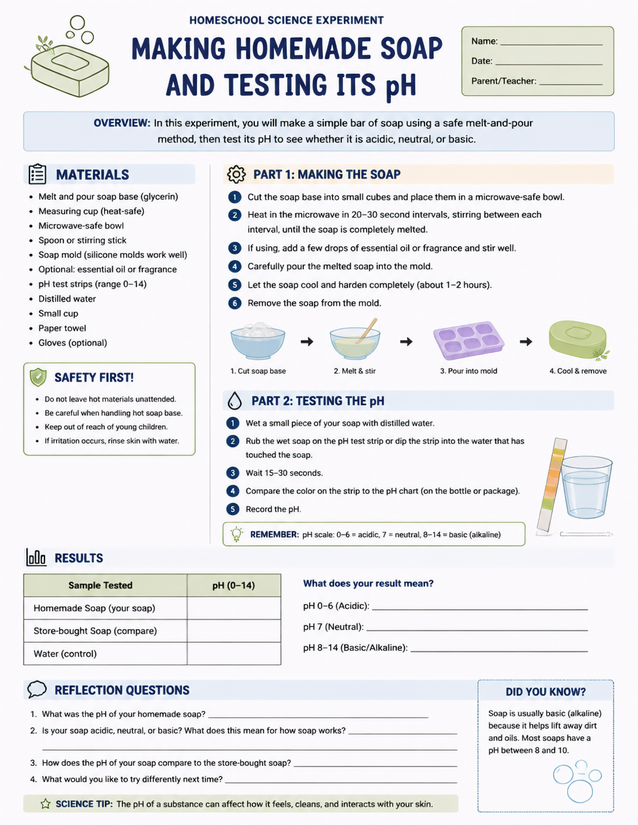
Your grades 4-7 homeschooler uses making homemade soap and testing its pH to discover whether soap is acidic or basic. Instant download.
Recording Results for Making Homemade Soap and Testing Its pH

Usage Notes
Most materials here are household or easily sourced: a microwave-safe bowl, a spoon, distilled water, and a silicone mold cover the basics. The sheet calls for glycerin melt-and-pour soap base and pH test strips rated for the full 0 to 14 range, which are specialty but inexpensive online or at a craft store. The safety panel warns against leaving hot soap base unattended and recommends keeping young siblings clear during the melting steps, so adult supervision is assumed throughout.

Printing Tips
Twenty-four-pound paper handles the pencil or pen writing your student will do during both parts of the lab without buckling under a damp hand. Slide the printed sheet into a plastic page protector inside a science binder so the results table stays clean near the workspace, and print a second copy if your student wants to run the comparison test a second time with different soap varieties.