Creative Minds 𖹭 Happy Hearts

Making Invisible Ink with Lemon Juice and Heat
Lemon juice writes nothing you can see until heat changes everything. Making invisible ink with lemon juice turns a chemistry lesson on oxidation into a secret message your student actually wants to send.
Making invisible ink with lemon juice gives grades 3-6 students a hands-on introduction to chemical change and oxidation. The sheet walks your homeschooler through a structured question and hypothesis before the experiment begins, then guides them through seven numbered steps: squeezing juice, writing a hidden message with a cotton swab or paintbrush, letting it dry, and revealing the message with a lamp, hair dryer, or iron. A dedicated observations section asks students to describe exactly what they saw, and the conclusion prompt asks whether their hypothesis held up.
This experiment fits naturally into a chemistry unit study or a broader physical science sequence on heat and matter. It works as a standalone lesson for a single afternoon, but the ‘Try This’ extension at the bottom, testing milk, baking soda solution, or vinegar as alternative inks, opens it into a multi-session comparison. Completing the sheet demonstrates your student’s ability to form a testable hypothesis, follow a controlled procedure, and connect a visible result to the underlying science.
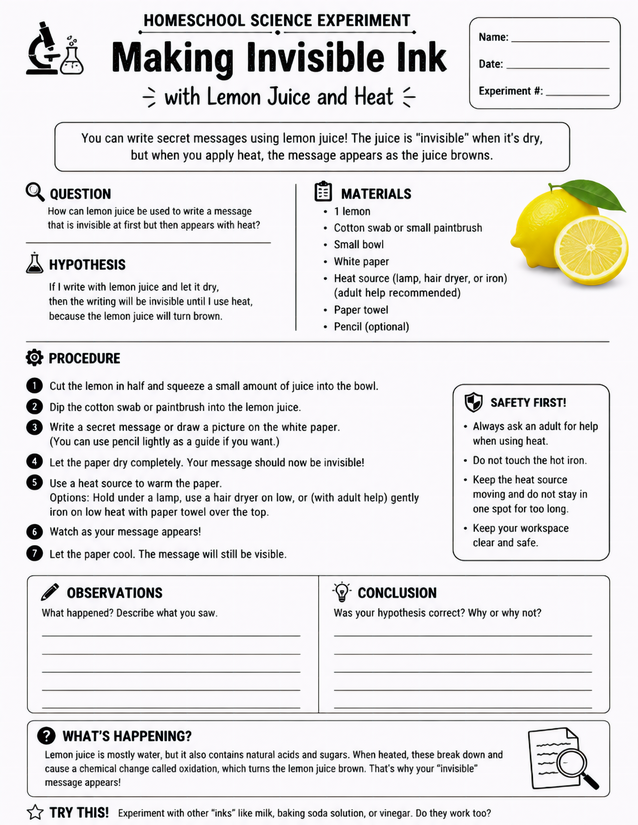
Grades 3-6 homeschoolers explore oxidation by making invisible ink with lemon juice in this structured experiment recording sheet.
Getting Started with Making Invisible Ink with Lemon Juice

Usage Notes
Every material on this sheet is a household item: one lemon, a cotton swab or small paintbrush, a small bowl, white paper, and a paper towel. The heat source is the only item requiring adult judgment. The sheet explicitly recommends adult help for the lamp, hair dryer, or iron step, and the Safety First panel asks students to keep the heat source moving and never touch a hot iron directly.

Printing Tips
Standard copy paper works well here since students write lightly with a cotton swab, not a pen. Punch holes and slip it into a three-ring science notebook after the experiment, or keep it loose on a clipboard during the reveal step so it is easy to hold under a lamp.