Creative Minds 𖹭 Happy Hearts

Making Soap from Oil and Lye, Saponification Lab Sheet
Sodium hydroxide and vegetable oil go in, soap and glycerin come out. Making soap from oil and lye is one of the few kitchen-table experiments where your student handles a genuinely caustic chemical under careful supervision.
Saponification is the chemical reaction at the heart of this experiment, and the sheet walks students through every stage of it. Starting with measuring 500 g of olive or vegetable oil and 64 g of sodium hydroxide lye, your student tracks temperature at each step, records observations as the lye dissolves in water, notes when the blended mixture reaches trace, and monitors the cure over 24 to 48 hours in the mold. Four open observation prompts and a Think and Discuss section push grades 6-9 students beyond procedure-following into actual scientific reasoning about evidence of chemical change.
Making soap from oil and lye fits naturally into a chemistry unit study on chemical reactions, properties of matter, or acids and bases. It can stand alone as a multi-day lab or anchor a broader unit on everyday chemistry. By the end, your homeschooler can articulate why the reactants change properties, explain why lye must always go into water rather than the reverse, and describe what physical cues signal that saponification has occurred.
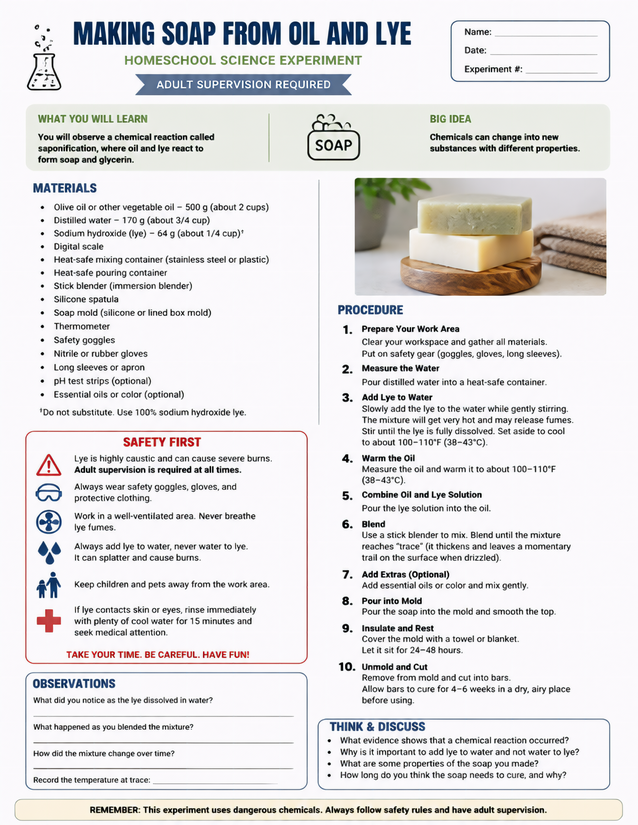
Observe saponification firsthand with this making soap from oil and lye homeschool experiment, suited for grades 6-9.
Investigating Making Soap from Oil and Lye Step by Step

Usage Notes
Sodium hydroxide lye is a specialty supply requiring careful sourcing. The sheet specifies 100% sodium hydroxide with a footnote that no substitutes are acceptable. Household items such as olive oil, distilled water, a digital scale, and a stick blender round out the list, but safety gear including nitrile gloves, safety goggles, long sleeves, and a heat-safe stainless steel or plastic container are non-negotiable before any measuring begins.

Printing Tips
Cardstock holds up better than copy paper if the sheet will sit near a work surface where hands are damp or oily. A clipboard keeps it accessible during the ten-step procedure without risking it in a lab binder until the experiment is complete.