Creative Minds 𖹭 Happy Hearts

Observing Ant Behavior in a Homemade Ant Farm, Science Lab Sheet
Ants tunneling through sand, carrying food, and following invisible trails make observing ant behavior in a homemade ant farm one of the most genuinely captivating live-animal experiments your homeschooler can run.
This lab sheet guides grades 3-6 students through a structured 20-30 minute observation session with live ants collected from outdoors. Your student records what the ants are doing, where they are located inside the farm, and sketches what they see, all in a timed observation table with columns for activity, location, and notes or drawings. The guiding question asks how ants behave as they explore, find food, and interact with one another, and a hypothesis section prompts your student to predict and explain before the experiment begins.
Observing ant behavior in a homemade ant farm fits naturally into an insects unit study or a broader life science sequence covering animal behavior and ecosystems. The sheet works as a standalone hands-on learning activity or as a companion to reading on social insects and colony communication. A conclusions section asks what your student learned, whether the hypothesis was correct, and what new question the experiment raised, making it a complete scientific thinking exercise from prediction through reflection.
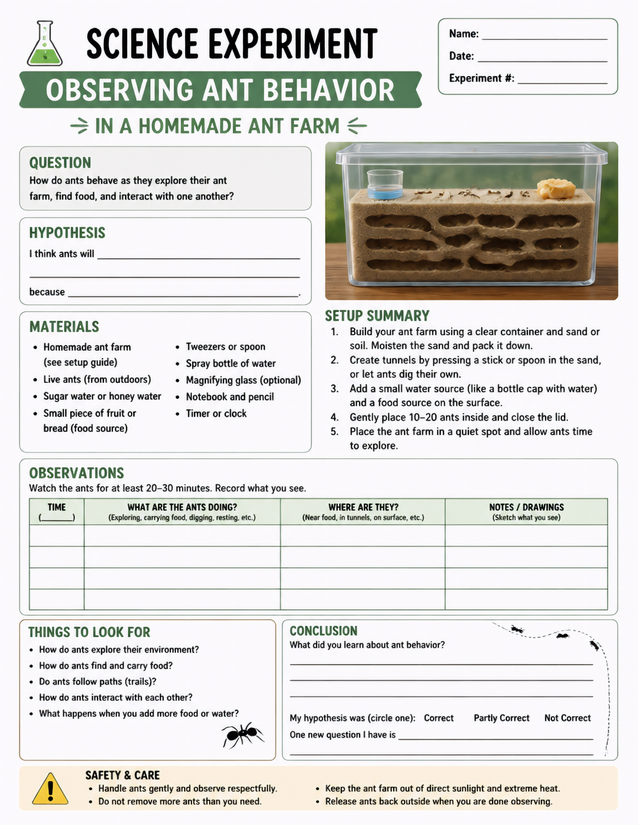
Watch live ants tunnel and forage with this observing ant behavior in a homemade ant farm lab sheet for grades 3-6 homeschoolers.
Setting Up Observing Ant Behavior in a Homemade Ant Farm

Usage Notes
Almost everything on the materials list is already in your home: a clear container, sand or soil, a spray bottle, tweezers or a spoon, sugar water or honey water, a small piece of fruit or bread, and a timer. The only variable is the ants themselves, which the sheet specifies collecting from outdoors. The safety section reminds students to handle ants gently, never remove more than needed, keep the farm away from direct sunlight and heat, and release the ants outside when observations are complete.
Printing Tips
A single loose sheet on a clipboard works well here since your student will be watching the ant farm and writing at the same time. Standard 20-lb copy paper is fine for pencil notes, but if you want the observation table to hold up through a longer multi-day study, 24-lb paper keeps the rows cleaner and resists smearing.