Creative Minds 𖹭 Happy Hearts

Observing Convection Currents with Food Coloring in Hot Water
Red dye sinks, then rises. Observing convection currents with food coloring turns an invisible physics concept into something your student can watch unfold in a drinking glass.
Observing convection currents with food coloring in hot water gives grades 4-7 students a clear, visual entry point into fluid dynamics and heat transfer. The sheet walks your student through a structured scientific method: forming a written hypothesis about what the food coloring will do, following a five-step procedure, and recording observations describing exactly how the color moves through the water. An embedded diagram labels warm water rising in red and cool water sinking in blue, giving your student a reference model to compare against what they actually see.
Three analysis questions push beyond simple observation, asking why the coloring moved as it did, where the warmest and coolest water sat in the glass, and how convection currents transfer heat in natural systems. That final question makes this lab a natural anchor for a broader earth science or physics unit study on weather, ocean circulation, or plate tectonics. Completing the sheet, your student demonstrates not just recall but the ability to connect a tabletop result to a larger scientific principle.
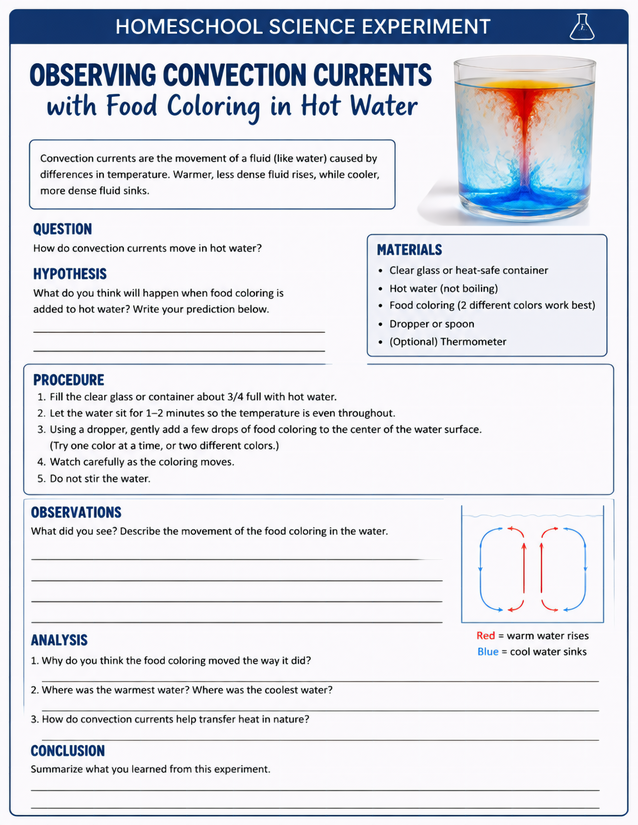
Drop food coloring into hot water and watch observing convection currents with food coloring become a vivid, hands-on lesson for grades 4-7.
Exploring Observing Convection Currents with Food Coloring

Usage Notes
Every material on this sheet is a household item: a clear glass or heat-safe container, hot (not boiling) water, food coloring in two colors, and a dropper or spoon. An optional thermometer is listed for students who want to measure temperature at different points in the glass. Remind your student not to stir the water at any point, since the procedure depends on undisturbed movement, and to handle the hot water carefully to avoid burns.
Printing Tips
A single loose sheet on a clipboard works well here so your student can write observations the moment the coloring starts moving without hunting for a notebook. Standard 20 lb copy paper holds up fine for pencil notes, though cardstock gives a sturdier surface if the sheet will be tucked into a science portfolio afterward.