Creative Minds 𖹭 Happy Hearts

Observing Firefly Luciferase Bioluminescence Principles Lab Sheet
Six test tubes, one glowing reaction, and a real enzyme at work. Observing firefly luciferase bioluminescence principles puts biochemistry in your student’s hands with actual luciferase and luciferin, not a simulation.
Luciferase catalyzes the reaction between luciferin, ATP, and oxygen to produce light, and this lab sheet walks your student through every variable. Designed for grades 7-10, the procedure sets up six test tubes, each omitting one component so your homeschooler can isolate exactly which inputs the bioluminescent reaction requires. Students record relative light output in the provided data table and answer five analysis questions connecting the lab results to how fireflies produce light in nature.
Observing firefly luciferase bioluminescence principles fits naturally into a biochemistry or enzymes unit study, and it works as a standalone lab when you want a high-engagement experiment that requires genuine scientific reasoning. Completing the sheet demonstrates that your student can design a controlled experiment, interpret comparative data, and explain enzyme function at a mechanistic level rather than just a definitional one. The Extend Your Learning section adds a temperature variable for students ready to push further.
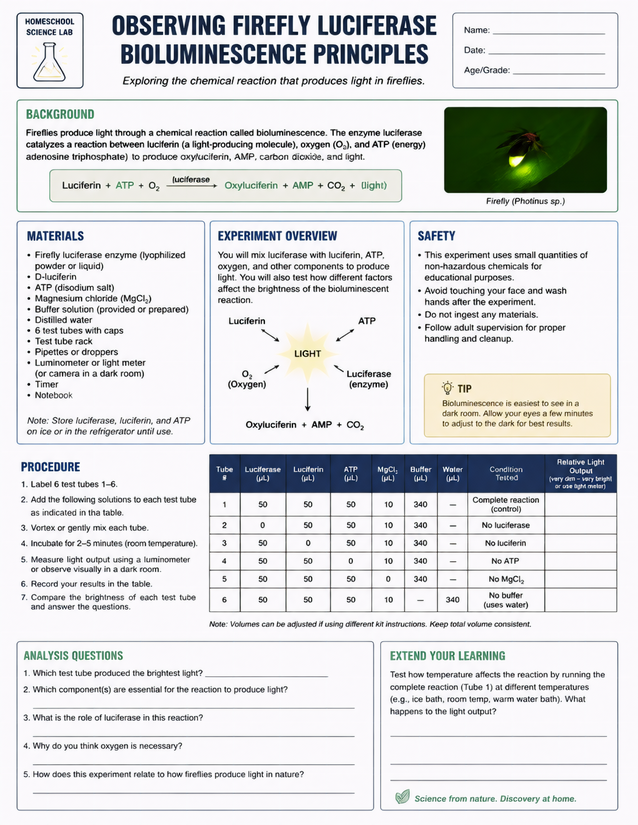
Grades 7-10 homeschoolers explore observing firefly luciferase bioluminescence principles across six controlled test tubes. Instant download included.
Investigating Observing Firefly Luciferase Bioluminescence Principles

Usage Notes
Luciferase enzyme (lyophilized powder or liquid), D-luciferin, ATP, magnesium chloride, and buffer solution are specialty biochemical supplies, typically purchased as an educational bioluminescence kit. Household items cover the rest: distilled water, test tubes with caps, a rack, pipettes, a timer, and a notebook. The safety panel on the sheet notes non-hazardous quantities for educational use but requires adult supervision, hand-washing after handling, and no ingestion of any materials.

Printing Tips
Card stock at 32 lb or heavier holds up well when students are pipetting near the page. Insert into a lab notebook after completing, or keep it as a loose sheet on a clipboard during the dark-room observation step so your student can record results immediately without extra handling.