Creative Minds 𖹭 Happy Hearts

Earthworms React to Vibrations in Soil Lab Sheet
Six to ten earthworms, a tuning fork, and moist potting soil are all it takes to watch how earthworms react to vibrations in soil in real time.
Your student places live earthworms in a soil-filled container, designates one end as the vibration end, and applies a tuning fork, speaker, or phone set to vibration mode for thirty-second intervals. Across three trials, they count how many worms move toward the vibration end, stay in the middle, or retreat to the far end, recording results in the data table on the sheet. This lab suits grades 3 to 6 and is a strong fit for homeschool nature study or an animal behavior unit.
The sheet guides your homeschooler through a full scientific process: writing a hypothesis, following a nine-step procedure, and answering three analysis questions before drafting a written conclusion. Observing earthworms react to vibrations in soil connects sensory biology to animal behavior without requiring any specialty equipment. A tip at the bottom of the sheet reminds students to keep the soil moist and return the worms outside when the experiment is done, making this a gentle, low-impact introduction to field-style biology.
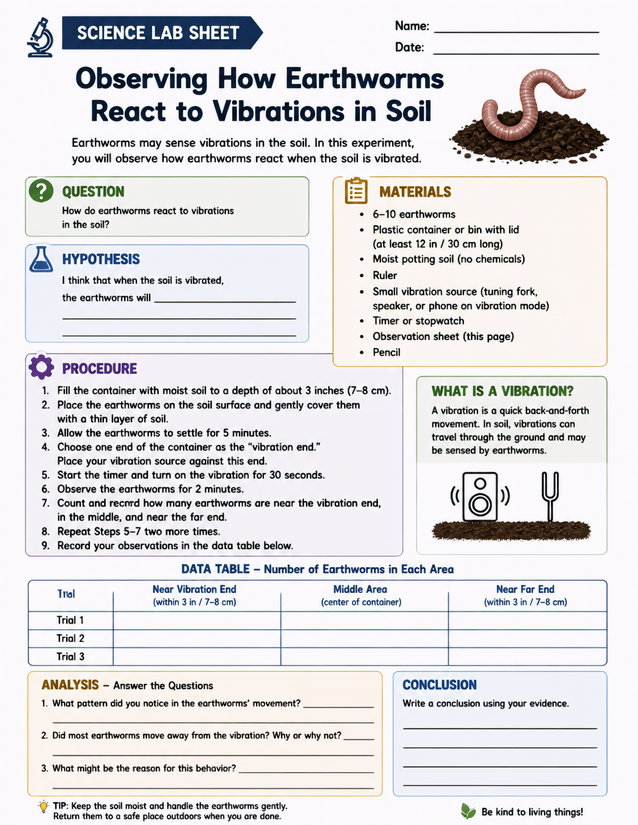
Grades 3-6 homeschoolers discover how earthworms react to vibrations in soil across three recorded trials. Download and print today.
Recording Results for Earthworms React to Vibrations in Soil

Usage Notes
Most materials here are household or garden items: a plastic bin, moist potting soil without chemical additives, a ruler, and a timer. The one specialty item is a vibration source, but the sheet lists a phone set to vibration mode as an option, so no tuning fork is required. Live earthworms should be handled gently and kept in moist soil throughout; the sheet includes a reminder to release them outdoors after the experiment.

Printing Tips
Standard 20 lb copy paper works fine, though 24 lb holds up better if students rest their hand on the sheet while writing during the experiment. Slip the loose sheet onto a clipboard so it stays flat while your student counts and records worms between trials. Laminating is not recommended here since students write in the hypothesis, data table, and conclusion fields.