Creative Minds 𖹭 Happy Hearts

Plants Distribute Water Through Stems Lab Sheet
Three white carnations, three jars of dyed water, and 48 hours is all it takes to watch how plants distribute water through stems in real time.
Your grades 3-6 homeschooler investigates how plants distribute water through stems using white carnations placed in red, blue, and green food-colored water. The sheet walks students through writing a hypothesis, following a six-step procedure that includes cutting stems at an angle, and recording timed observations at the start, after 6-12 hours, after 24 hours, and after 48 hours. The observation table asks students to note changes to both the stem and the petals, and includes a drawing column for each time point.
This lab fits naturally into a plant biology or botany unit study and works just as well as a standalone lesson on xylem and capillary action. A science tip on the sheet introduces the vocabulary word xylem directly, so your student encounters the term in context while the evidence is right in front of them. Completing the sheet means demonstrating not just observation skills but the ability to connect a written hypothesis to physical results, making it a solid introduction to the scientific method for elementary and middle grades.
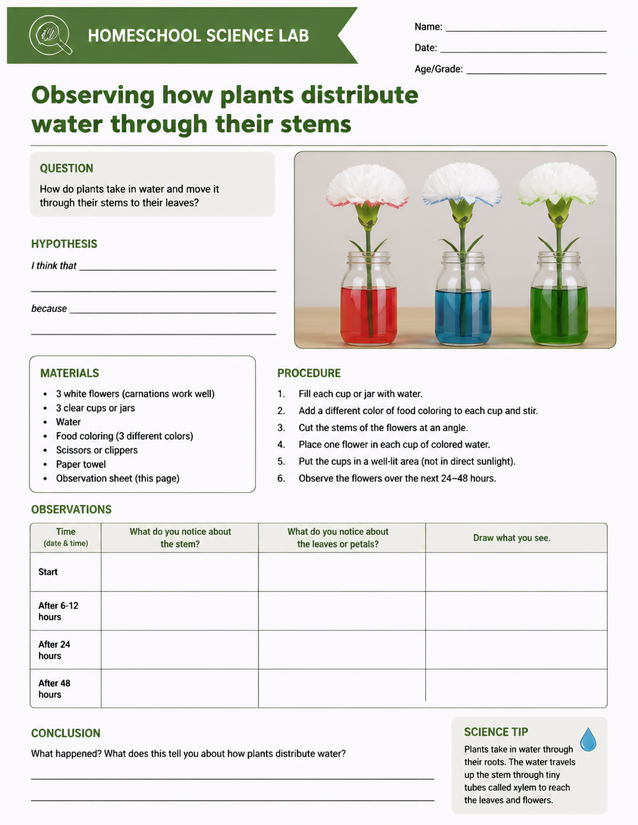
White carnations reveal how plants distribute water through stems in this grades 3-6 homeschool lab. Observations recorded over 48 hours.
Investigating Plants Distribute Water Through Stems

Usage Notes
All materials listed are household or grocery-store items: white carnations, clear cups or jars, water, food coloring in three colors, scissors or clippers, and paper towels. No specialty supplies are required. Scissors are the only tool that warrants a brief safety reminder for younger students when cutting stems at an angle.

Printing Tips
Standard 20 lb copy paper works fine, but 24 lb paper holds up better if a student’s hands are wet from handling the jars. Print one sheet per student and keep it loose or clipped to a clipboard near the experiment so timed observations can be filled in quickly each time the student checks the flowers.