Creative Minds 𖹭 Happy Hearts

Salinity Affects the Density of Water Lab Sheet
Five cups labeled 0% through 4% tell the whole story: when salinity affects the density of water, a floating grape or cherry tomato is all the proof your student needs.
Your grades 4-7 homeschooler works through a structured investigation into how salinity affects the density of water by mixing five salt concentrations, from fresh water up to a 4% solution, and testing whether a small object sinks, floats, or hovers in each. The sheet walks through labeling cups, measuring table salt in level teaspoons, stirring until fully dissolved, and recording sink-or-float results in a four-column data table. An optional food coloring step lets students visualize the solutions side by side before the floating test begins.
This lab fits naturally into an earth science or physical science unit study covering ocean properties, buoyancy, or solutions and mixtures. It works as a standalone session or as the hands-on anchor before a lesson on why the Dead Sea keeps swimmers afloat. By the conclusion section, your student explains what changed as salt concentration rose and states a claim about how salinity affects the density of water, practicing the observe-predict-conclude sequence that builds scientific reasoning across middle grades.
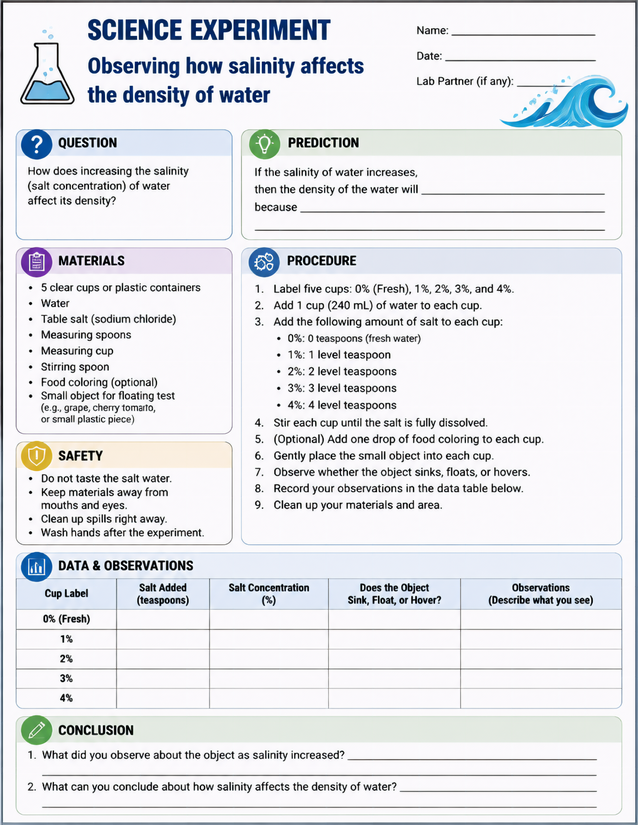
Five cups, five salt concentrations, one clear answer: salinity affects the density of water. Grades 4-7 homeschool science experiment, instant download.
Investigating Salinity Affects the Density of Water Step by Step

Usage Notes
Every supply on the materials list is a household staple: clear cups or plastic containers, table salt, measuring spoons, a measuring cup, a stirring spoon, and a small dense object like a grape or cherry tomato. Food coloring is listed as optional. No specialty supplies are needed, and setup takes under ten minutes. The safety section reminds students not to taste the salt water and to keep materials away from mouths and eyes, a standard reminder worth reading aloud before the lab begins.

Printing Tips
Slip a copy into a plastic page protector inside your science lab notebook so the procedure stays visible while your student works at the table. For the data table, a plain 20 lb sheet works fine, but 24 lb copy paper holds up better if cups drip during the floating test.