Creative Minds 𖹭 Happy Hearts

Salt Affects Boiling Point of Water Lab Sheet, Homeschool Experiment
Two saucepans, a thermometer, and one teaspoon of table salt are all it takes to test how salt affects boiling point of water in your own kitchen.
Your student measures 250 mL of water into two saucepans, adds salt to one, heats both, and records the exact temperature when each reaches a steady boil. The results table on this salt affects boiling point of water lab sheet captures amount of salt, time to boil in minutes, boiling point in degrees Celsius, and written observations side by side, making the comparison impossible to miss. Suited for grades 5-8, the sheet closes with three reflection questions that push your homeschooler to explain why the temperatures differed, not just report that they did.
This experiment works as a standalone kitchen lab or as an anchor activity inside a unit study on solutions, colligative properties, or states of matter. Completing it gives your student concrete data to reference when you later introduce the concept of boiling point elevation, and the think-about-it section builds the habit of connecting numbers to physical explanation. No specialty supplies are needed, so you can run it any day the stove is available.
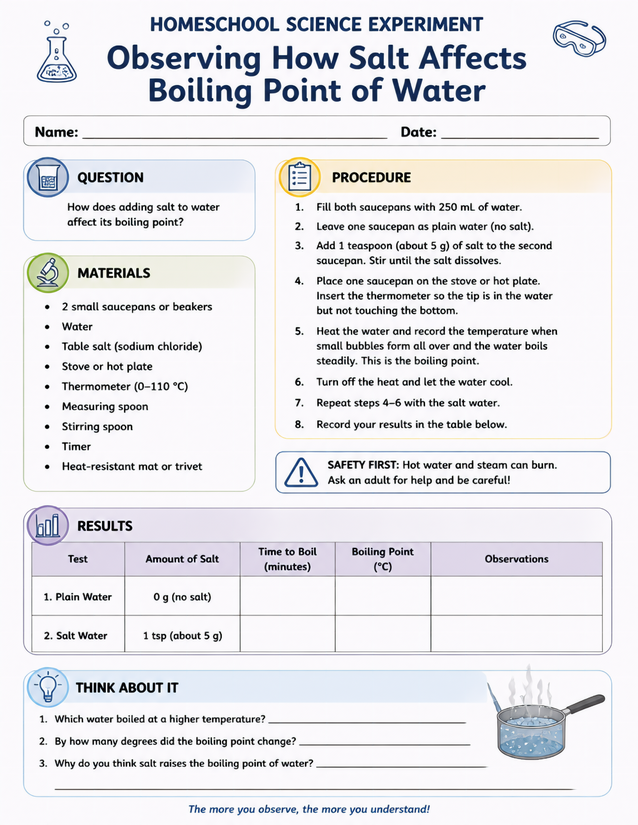
Does salt really raise the boiling point of water? This salt affects boiling point of water lab sheet is ideal for grades 5-8 homeschoolers.
Getting Started with the Salt Affects Boiling Point of Water Lab

Usage Notes
Everything on the materials list lives in a typical home kitchen: two small saucepans or beakers, table salt, a measuring spoon, a stirring spoon, a timer, and a 0-110 degrees Celsius thermometer. The thermometer is the one item families may need to source if they do not already own one. The sheet includes a safety note reminding students that hot water and steam can burn, so adult supervision is required for all heating steps.

Printing Tips
Standard 20 lb copy paper works fine here, but 24 lb paper holds up better when a student is writing near a warm stove. Print one sheet per trial and slip it into a plastic sheet protector inside your lab notebook, or clip it to a clipboard positioned away from the heat source for easy reference during the experiment.