Creative Minds 𖹭 Happy Hearts

Observing Osmosis with Potato Slices in Saltwater
Three cups, three salt concentrations, one potato. Observing osmosis with potato slices gives your student a front-row seat to water moving across a membrane in real time.
Your student weighs three potato slices before placing each one into a labeled cup of plain water, low-salt solution (3%), or high-salt solution (10%). After 60 minutes at room temperature, they re-weigh each slice and record both the mass change in grams and the appearance and texture in the observation column. The sheet walks grades 5-8 homeschoolers through a full scientific method cycle, from writing a hypothesis through answering five analysis questions that ask them to compare results and predict what a stronger salt concentration would do.
Observing osmosis with potato slices fits naturally into a cell biology unit study or a broader life science sequence covering membranes and diffusion. It works as a standalone one-session lab or as a companion to a lesson on concentration gradients. By the time your student writes the conclusion paragraph at the bottom of the sheet, they have gathered evidence, explained a mechanism, and connected their data to the definition of osmosis printed in the reminder box.
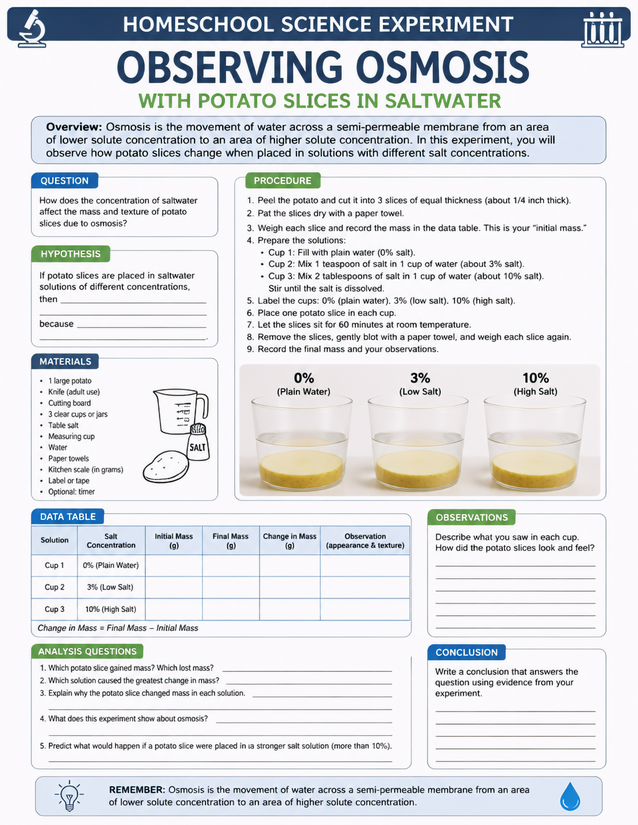
Grades 5-8 homeschoolers test observing osmosis with potato slices across three salt concentrations in this 60-minute experiment.
Getting Started with Observing Osmosis with Potato Slices

Usage Notes
Every material on the list is a household staple. Your student will need one large potato, table salt, a measuring cup, three clear cups or jars, paper towels, and a kitchen scale that reads in grams. A knife is required to cut the potato into equal slices, so adult supervision during that step is the one safety note the sheet flags explicitly.

Printing Tips
Standard 20 lb copy paper works for a single-session lab, but 24 lb paper holds up better if your student rests a wet hand on the sheet while recording masses. Slip it into a plastic page protector inside a lab notebook to keep it dry during the 60-minute soak period.