Creative Minds 𖹭 Happy Hearts

Observing Polarized Light with Polarizing Filters, Malus’s Law
Rotate one filter in front of another and watch the light go nearly dark. Observing polarized light with polarizing filters makes an abstract physics concept click in about ten minutes.
This lab sheet walks your student through a structured investigation of how two polarizing filters interact when one is rotated relative to the other. The question section asks how filter angle affects transmitted light, and the data table prompts brightness readings at seven angles from 0 to 90 degrees. A diagram explains Malus’s Law (I = I₀ cos²θ) directly on the sheet, giving grades 6-9 homeschoolers a concrete bridge between their observations and the underlying math. The background section covers why light waves vibrate in multiple directions and what a polarizing filter does to restrict that vibration, so your student reads the theory before they test it.
The observing polarized light with polarizing filters lab fits naturally into a unit study on waves, optics, or the electromagnetic spectrum. Three conclusion prompts ask students to connect results back to their hypothesis and identify the angle of minimum transmission, while three Think Further questions push toward real-world applications like camera lenses and LCD screens. Completing it demonstrates that your homeschooler can collect systematic data, apply a physical law to their own measurements, and draw evidence-based conclusions.
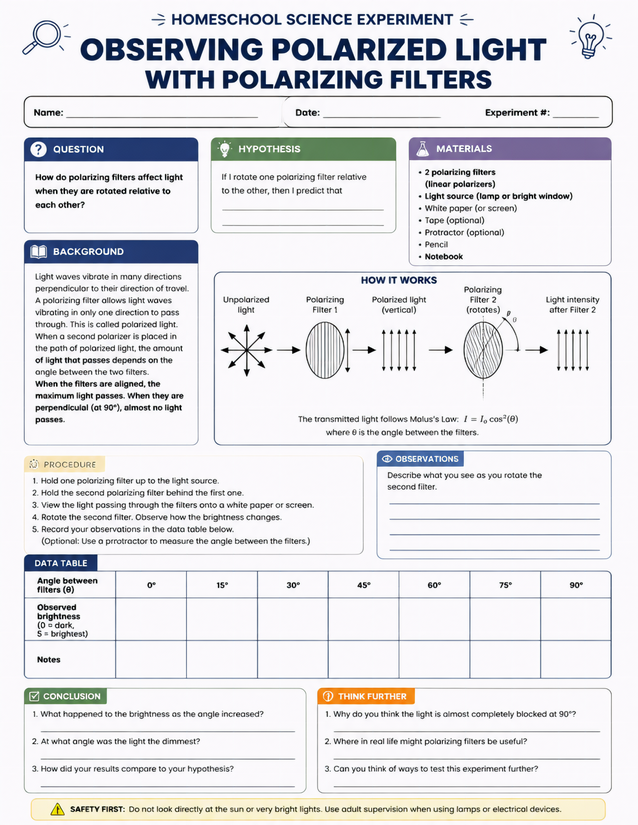
Grades 6-9 homeschoolers test Malus’s Law with this observing polarized light with polarizing filters lab sheet. Instant download.
Investigating Observing Polarized Light with Polarizing Filters

Usage Notes
Two linear polarizing filters are the only specialty item here. Everything else on the materials list, a lamp or bright window, white paper, pencil, notebook, and optional tape and protractor, is already in most homeschool households. No chemicals or heat sources are involved, but the sheet includes a safety note reminding students not to look directly at the sun or very bright lights and to use adult supervision with lamps.
Printing Tips
Standard 20 lb copy paper works fine for pencil entries, but 24 lb paper holds up better if the sheet rests on a clipboard while your student rotates filters with both hands. Slip it into a plastic sleeve or lab notebook after completing the data table to keep the angle measurements readable for review.