Creative Minds 𖹭 Happy Hearts

Snail Locomotion on Different Surfaces Lab Sheet
Snail locomotion on different surfaces turns a backyard creature into a genuine controlled experiment, with timed runs, distance measurements, and real data your student records themselves.
Centered on the question of how surface type affects snail movement, this lab sheet walks grades 3-6 homeschoolers through a structured, repeatable experiment using one live snail and common household materials. Students write a hypothesis, time the snail across seven named surfaces including smooth plastic, glass, paper, cardboard, fabric, sandpaper, and leaf, then measure distance traveled in centimeters and describe movement quality in a data table with columns for distance, movement description, and ease of movement.
Observing snail locomotion on different surfaces fits naturally into a unit study on animal adaptations, invertebrate biology, or basic experimental design. The sheet works as a standalone investigation or as one of several animal behavior labs in a sequence. By completing the six analysis and conclusion questions, your student demonstrates the ability to identify patterns, compare variables, and draw evidence-based conclusions from their own recorded data.
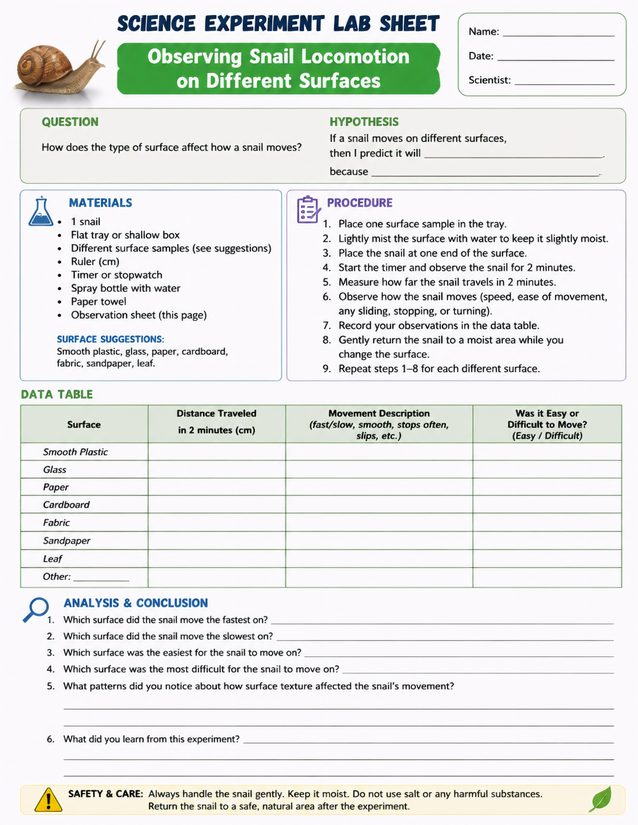
Grades 3-6 homeschoolers test how a snail locomotion on different surfaces affects speed and ease of movement. Instant download.
Recording Results for Snail Locomotion on Different Surfaces

Usage Notes
Most materials on this sheet are standard household items: a flat tray or shallow box, a ruler, a timer, a spray bottle with water, and paper towel. The one specialty requirement is a live snail, sourced from a garden or purchased from a pet or bait supplier. The sheet includes a prominent safety and care note reminding students to handle the snail gently, keep it moist, avoid salt or harmful substances, and return it to a natural area after the experiment.
Printing Tips
A single sheet clipped to a clipboard keeps the data table flat and easy to write on while your student is actively timing and observing. Standard 20 lb copy paper works fine, though 24 lb holds up better if the surface area around the tray gets damp during the misting steps.