Creative Minds 𖹭 Happy Hearts

Cacti Water Storage Adaptation Lab Sheet, 10-Day Observation
Dry periods reveal a lot. This cacti water storage adaptation lab sheet gives your student a front-row seat to ten days of measurable change in a single living plant.
Your student starts by forming a hypothesis about how cacti collect, store, and conserve water, then spends ten days weighing a potted cactus and recording observations about its appearance, firmness, and color. The sheet structures the experiment in three distinct phases: baseline before any watering, a seven-day dry period, and three recovery days after a small controlled watering. Designed for grades 4-7 in a homeschool setting, the cacti water storage adaptation lab sheet gives students a concrete way to connect desert plant biology to measurable, physical data they collect themselves.
This fits naturally into a botany or desert ecosystems unit study and works well as a standalone long-form observation project. The data table runs from Day 0 through Day 10, with columns for mass in grams, physical observations, and a drawing or photo reference. Analysis questions ask your student to explain what changed during the dry period and what adaptations helped the plant survive, and the conclusion section requires them to synthesize ten days of evidence into a written explanation.
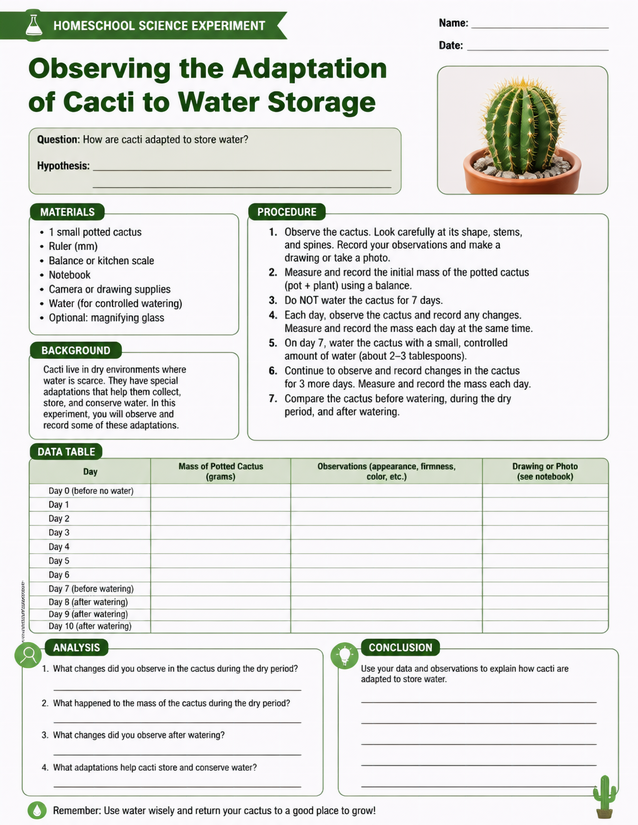
A cacti water storage adaptation lab sheet for grades 4-7 homeschoolers tracking mass, appearance, and spine changes over ten days.
Recording Results for the Cacti Water Storage Adaptation Lab Sheet

Usage Notes
Nearly everything on the materials list is a household item your student likely already has: a ruler, a notebook, and drawing supplies. The one specialty item is a balance or kitchen scale accurate enough to detect small changes in grams, since mass loss during the dry period is the key measurable in this experiment. No chemicals or safety hazards are involved, though younger students should handle the cactus carefully given the spines.

Printing Tips
Standard 20 lb copy paper works for daily entries, but 24 lb paper holds up better if your student is pressing firmly while writing at a desk beside the plant. Slip it into a lab notebook after Day 0 so all ten days stay together and the drawing reference column stays aligned with the right notebook pages.