Creative Minds 𖹭 Happy Hearts

Fruit Flies Attracted to Different Odors Lab Sheet
Fruit flies attracted to different odors make surprisingly deliberate choices, and your student gets to find out which smell wins by counting flies every five minutes.
Your student begins by forming a hypothesis about which odor will draw the most flies, then sets up three labeled stations in a clear tray: vinegar, ripe banana, and sugar water. The sheet walks through an eleven-step procedure, a timed five-minute observation window, and a three-trial data table with an average row. Designed for grades 3-6, this homeschool lab sheet teaches fair-test principles alongside basic animal behavior science.
The experiment fits naturally into a unit study on animal senses, insect biology, or scientific method, and the fruit flies attracted to different odors concept connects to broader lessons about how organisms use chemoreception to locate food. A student who completes all three trials and the analysis section demonstrates not just data collection but the ability to interpret results and propose follow-up questions, exactly the kind of reasoning the sheet’s Think Further prompt is designed to push.
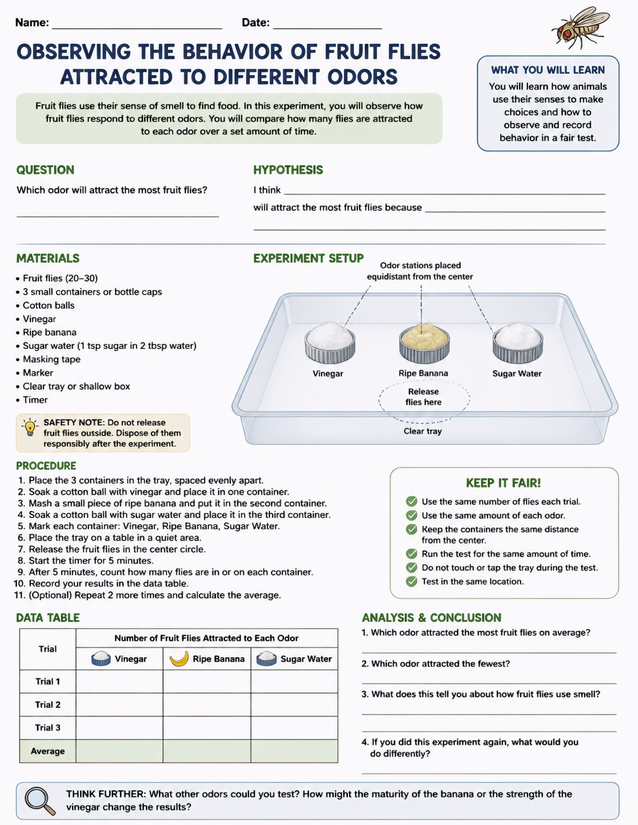
Grades 3-6 homeschoolers explore how fruit flies attracted to different odors choose vinegar, banana, or sugar water. Instant download.
Setting Up the Fruit Flies Attracted to Different Odors Experiment

Usage Notes
Every material on the list is a household item: fruit flies (20-30), three small containers or bottle caps, cotton balls, vinegar, a ripe banana, sugar water mixed at one teaspoon sugar to two tablespoons water, masking tape, a marker, a clear tray or shallow box, and a timer. No specialty supplies are needed. The sheet includes a printed safety note reminding students not to release fruit flies outdoors and to dispose of them responsibly after the experiment.

Printing Tips
Card stock holds up better than copy paper if the tray experiment runs multiple trials back to back and hands are near the sheet. Loose on a clipboard works well here since students are counting and recording quickly during the five-minute window, and the three-trial data table makes laminating impractical unless you plan to write with a dry-erase marker.