Creative Minds 𖹭 Happy Hearts

Chromatography of Different Markers Lab Sheet
Washable markers hide more colors than your student expects. This chromatography of different markers lab sheet turns a jar of water and a coffee filter into a genuine color-separation experiment.
Your student starts by writing a prediction, then cuts coffee filter strips, marks a dot with each washable marker, and suspends the strips over 2 to 3 cm of water using a pencil and clothespin. As the water climbs the paper, the dye components separate into distinct bands, and three labeled observation boxes ask students to draw or describe exactly what they see for each marker color. The sheet is well matched to grades 3 through 6 and slots naturally into a chemistry or physical science unit study focused on mixtures and separation techniques.
The chromatography of different markers experiment works as a standalone one-session lab, but it also pairs cleanly with lessons on color, light, or the properties of water. Completing the sheet requires your homeschooler to form a testable prediction, follow a sequential eight-step procedure, record direct observations, write a conclusion, and answer a comparison question about which marker yielded the most colors and why. That full cycle from question to reflection gives you a complete scientific method record in a single printed page.
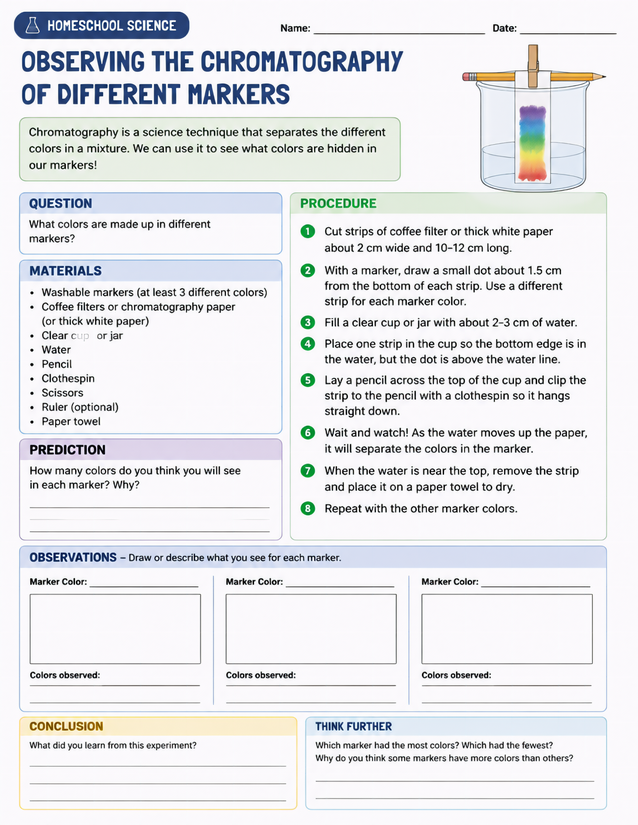
Separate hidden colors with this chromatography of different markers lab sheet for grades 3-6 homeschoolers. All materials are household items.
Investigating Chromatography of Different Markers at Home

Usage Notes
Nearly everything on the materials list is already in most homes: washable markers in at least three colors, coffee filters or thick white paper, a clear cup or jar, water, a pencil, a clothespin, scissors, and a paper towel. Chromatography paper works best but is not required. No heat or chemicals are involved, so this experiment carries no significant safety concerns for the grade range.

Printing Tips
Standard 20 lb copy paper is fine for single-use recording, but 24 lb or card stock holds up better if your student rests a hand on the sheet while drawing in the observation boxes. Loose sheets on a clipboard work well beside the experiment setup, or punch and insert into a science lab notebook after the strips have dried.