Creative Minds 𖹭 Happy Hearts

Electromagnetic Radiation on Seeds Lab Sheet, Five Light Treatments
Five light treatments, twenty-plus seeds, and ten days of daily observation: the electromagnetic radiation on seeds lab sheet turns a windowsill into a working experiment on germination and early plant growth.
Your student tests how control, visible light, infrared, ultraviolet, and complete darkness each affect seed germination and early growth over seven to ten days. The electromagnetic radiation on seeds lab sheet walks through all six procedure steps, a ten-row daily data table, four analysis questions, and a written conclusion, making it a complete self-contained record for grades 6-9. The experiment fits naturally into a physics or life science unit study focused on light energy and plant biology. Completed correctly, it demonstrates your homeschooler’s ability to design a controlled experiment, maintain consistent variables across five containers, and draw evidence-based conclusions about how electromagnetic radiation influences living systems.
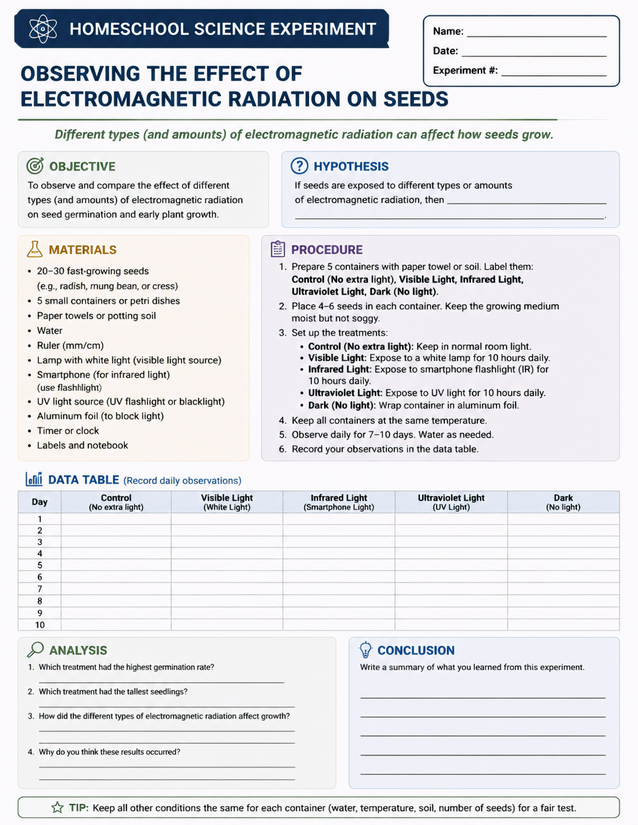
Compare how five light treatments affect germination with this electromagnetic radiation on seeds lab sheet, designed for grades 6-9 homeschoolers.
Investigating the Electromagnetic Radiation on Seeds Lab Sheet

Usage Notes
Most materials are already in the house: containers or petri dishes, paper towels or potting soil, water, a ruler, a timer, and aluminum foil. The smartphone flashlight doubles as the infrared source, so no specialty equipment is needed there. A UV flashlight or blacklight is the one item that may require a quick purchase, and no chemical hazards are involved.

Printing Tips
Standard 20 lb copy paper works fine here, but 24 lb gives the data table cells enough body to hold pencil entries through ten days of daily recording. Print a single sheet and slip it into a clear page protector inside your student’s lab notebook, or keep it loose on a clipboard next to the containers where observations happen.